Showing posts with label motherhood. Show all posts

Friday, January 28, 2011

Buzz: A Year of Paying Attention: Book Review

I read Katherine Ellison's article - Doing Battle with the ADHD-Industrial Complex - when it was published a few months ago. I thought it was an interesting and insightful piece, and promptly put her new book on my to-read list. I wasn't really looking forward to reading Buzz, though.

I've read a lot of books on ADHD, OCD, and Tourette's Syndrome and related disorders (including autism spectrum disorders) over the past ten years. You can see some of these books on the disability shelf in my goodreads account here, and some information on Tourette's and Tourette's Syndrome Plus (TS+) here and here

The books I've read include memoirs, parenting and teacher advice, therapeutic manuals, and fiction aimed at all ages. Some of these books were enlightening, some were depressing, and some should be required reading for anyone dealing with these issues. I wish I had enough money to buy copies of Ross W. Greene's The Explosive Child for every parent who would benefit from it, and enough copies of Lost at School and Challenging Kids, Challenged Teachers for every administrator, teacher, and paraprofessional (i.e., teacher's aide) who needs to read these books.

Anyway, I thought Katherine Ellison would be preaching to the choir in Buzz, and that it was unlikely she would tell me anything new, or describe any personal experiences I hadn't already lived myself. Then the book became available on my library request list. Even though the cover gave me a headache with its vibrating-look title (and the library's fluorescent ID sticker went right through the middle of the legs in the center, making them look like some weird butterfly wearing Converse high tops), I gave it a try. 

I was hooked by the first chapter. Ellison describes her "bad mom moments" in unflinching detail, along with graphic descriptions of her son's defiance, anger, and confusion. After one particularly memorable incident, Ellison resolves to turn her attention and considerable skills at investigative journalism to ADHD in general, and to her son (who goes by the nickname "Buzz") in particular, for the next year.

Her account of her year of research, experimentation, expense, family life, and community is fascinating. She examines medication, therapy, support groups, neurofeedback, meditation, and several other approaches to dealing with ADHD. There's a bit about the history of most of these ideas, interviews with mental health professionals and other practitioners, and interesting accounts of her experiences and her son's.  I'd heard of many of these approaches - but reading about the details of the practices was cool in a whole different way. It reminded me of Mary Roach's popular science books (like Stiff), actually. And I really appreciated the detailed end notes (complete with references), and a useful index.  

When I read about the meditation technique of mindfulness that Nirbhay Singh recommends for defusing anger, for instance, I was able to turn to the research in the endnotes, and then look Singh's articles up online. My son and I both read Singh et al.'s Meditation on the Soles of the Feet Training, and though he didn't particularly like thinking about his feet, he was able to focus his concentration on something else in a similar manner to help calm himself the other day. This is an approach I hadn't ever seriously considered.


Ellison's descriptions of her family's ordeals and triumphs during this year is equally engaging, and adds a certain (sometimes dark) humor to the narrative that kept me reading. I did wish that there was more about schools and educational advocacy in Buzz, and Ellison mentions that she became aware of this lack when it was too late for her to use the information effectively (in the epilogue). 


One work that complements Buzz particularly well is Judith Warner's recent book on children and mental health: We've Got Issues: Children and Parents in the Age of Medication


In short - it's definitely worth turning your attention to Buzz, whether you have to deal with attention deficits and/or hyperactivity or not.


Tuesday, August 18, 2009

Until Our Hearts Are On the Ground

Here's the last book review that I've done in the last few years for a website that is no longer maintained (but that can still be accessed via the Wayback machine). The Association for Research on Mothering (ARM) holds fascinating conferences and publishes an incredible diversity of books on motherhood (this year's on blogging).

"Until Our Hearts Are On the Ground”: Aboriginal Mothering, Oppression, Resistance and Rebirth, edited by D. Memee Lavell-Harvard and Jeannette Corbiere Lavell, is an eye-opening and diverse collection of papers published by Demeter Press, the publishing division of York University's Association for Research on Mothering.

The book's title comes from a Cheyenne proverb:


“A nation is not conquered until the hearts of its women are on the ground. Then it is done, no matter how brave its warriors nor how strong their weapons.”

Until Our Hearts Are On the Ground's diversity is both its strength and a minor drawback. The multiple voices, different indigenous peoples, varied histories, and the personal experiences of motherhood that Lavell-Harvard and Lavell (mother and daughter editors) bring together are amazing, but the diversity is sometimes overwhelming. It can be difficult to switch gears between the different topics and styles of writing in the contributions. Lavell-Harvard and Lavell acknowledge this in the first paper ("Thunder Spirits: Reclaiming the Power of Our Grandmothers"), noting that "There is such a range of Aboriginal women's experiences existing somewhere between "traditional" and "modernized" that perhaps the only thing we do share is what Mihesuah calls a 'commonality of difference'"(p. 2).

They go on to eloquently and convincingly explain how:


"the historical persistence of our cultural difference generation after generation (despite the best assimilative efforts of both Church and State) is a sign of our strength and our resistance. That we have historically, and continually, mothered in a way that is "different" from the dominant culture, is not only empowering for our women, but is potentially empowering for all women (p. 3)."

Lavell and Lavell-Harvard do a skillful job of organizing the diverse works into four sections: one on pregnancy and becoming a mother, the ideology and practice of motherhood, the state's influence on motherhood, and literary representations of motherhood.. And the references and the endnotes are remarkable - there are scads of wonderful, intriguing sounding articles, books, and papers from the most obscure places in each article's references.


A few of the papers are written in an academic style that can be off-putting for those not accustomed to it. If you persevere, however, the insights into different cultures and social groups, and the historical understandings gained, are definitely worth a few obtuse paragraphs of sociology, medical anthropology, ethnohistory, or literary analysis. I learned something, or was moved, or came to a new appreciation for the strength that the mothers portrayed have shown in the face of incredible hardship in every single one of the papers in this book.


The seventeen papers include reflections on motherhood amongst the Anishnaabe (Ojibway) of Canada, cultural and personal implications of the medicalization of birth (among Anishnaabe and Mi'kmaq communities), a fascinating look at historic Haudenosaunee (Iroqouis) mothering (especially interesting for those studying non-patriarchal societies and/or gender equality) , and one Metis mother's powerful account of how traditional parenting skills programs made a difference in her life.


“Back to Basics” describes mothering, and the impact that grandmothers and aunts - also prominent in several of the earlier papers on Canada - have on children’s survival (especially from kwashiorkor) in urban Ghana. On my first look at the book, I thought that Africa was a far cry from Canada, and wondered how this piece could possibly fit in with the other papers, but the authors do show how colonization and various forms of oppression have had a similar effect on motherhood in many areas of Africa, North America, and Australia. Similarly, three papers on Aboriginal mothers in literature, including works by authors Leslie Marmon Silko, Louise Erdrich, and Nugi Garimara (aka Doris Pilkington, the author of Follow the Rabbit-Proof Fence) fit well in this book.


"Aboriginal Mothering: An Australian Perspective" provides an important look at "the Stolen Generation" (which many North Americans first heard about in the movie The Rabbit-Proof Fence), focusing on how women and families are re-connecting after the long period of cultural genocide that happened when children were taken by the Australian government in the years between 1905-1970. This paper is fittingly followed by a couple of papers on Canadian state child protection policies and indigenous mothers, the history and lingering effects of Canada's residential schools, and a short but revealing look at the impact of Canada's Indian Act and its context in colonization and oppression, authored by the editors.


As described on page 188, Jeannette Corbiere Lavell (one of the editors and co-author of "Aboriginal Women vs. Canada" ) was the first woman to challenge the section of the Indian Act's Section 12(1)(b), which was finally amended by Bill C-31 in 1985. As an American, I had heard the Canadian term "status Indian", but I was unfamiliar with the implications of how the Canadian Indian Act worked (and continues to work with its 1985 modifications). As Lavell and Lavell-Harvard describe,


"For well over a hundred years, beginning in the 1870s and continuing until as recently as 1985, under the provisions of section 12(1)(b), upon their entrance into marriage with a man not possessing Indian Status, the Canadian government stripped tens of thousands of Aboriginal women (and any subsequent children) of their Indian Status, and all the rights such status entailed including access to health care, education, and perhaps most importantly the right to live in their own homes and communities. Conversely, under the Act, not only did Indian men not lose status upon marriage to a non-aboriginal, their spouses gained status as did their children...Furthermore, since the extinguishment of Indian Status was irrevocable, many Aboriginal women were left without recourse in the even of domestic violence, divorce, or widowhood (p. 187)."

As Lavell and Lavell-Harvard point out, Bill C-31 (which restored Indian status to over 100,000 people)

"has simply created several new categories of Indian and only postponed the extinguishment of Indian status a couple of generations. While Lavell, and many other women like her, were reinstated as 6(1) Indians, her three children were classified as 6(2) Indians, which means their children, her grandchildren, will only be considered Indians should her children marry status Indians. Should her children marry non-Indians, her grandchildren will automatically be considered non-Indian. In a sad twist of fate, or perhaps a particularly ingenious governmental trick, Lavell's struggle for the right to marry whomever she pleases and still remain an Indian is currently being relived by her children" (p. 191).

This papers in this part of the book - the section titled "'Big Mother': The Role of the State in the Performance of Mothering" - are the most disturbing to read, but also the most illuminating.

I believe that most readers will come away from Until Our Hearts Are On the Ground with a deeper understanding of how history (and current government policies) affect families through their actions on mothers and mothering, as well an enduring admiration for the women who showed such strength in the past, and who continue to fight for their rights today. Until Our Hearts Are On the Ground also demonstrates the richness and diversity of Aboriginal motherhood, and should lay the idea that there is "one right way to mother" permanently to rest.


Wednesday, July 15, 2009

Perfect Madness: Book Review


Again, a couple of book reviews from 2005 that were lost in the ether, retrieved by the magic of the Wayback machine. I fixed a couple of spelling errors, love that Firefox add-on.

Perfect Madness or Localized Insanity?

Well, I finished reading Perfect Madness: Motherhood in the Age of Anxiety, by Judith Warner today.

I was very disappointed. The reviews were better than the book (and a lot more coherent). She totally disses Mothers & More and other similar groups, by the way, as:

“utterly corrupted by the competing religions of the American left and right”….(they) “purport to unite working and nonworking mothers alike in an ecumenical, pro-family social agenda. Their organizers, I found, were committed to this vision, and strove to make it a reality. But their membership, carried over from their pre-name-change days, was another story. Once you scratched the surface of their pro-unity slogans, all too often, something quite different emerged. Competition. Intolerance. And a big dose of sanctimony. Coming, most notably, from stay-at-home mothers seeking validation for the “sacrifices” they’d made in the name of motherly virtue” (p. 265-266).

It’s possible that other chapters are a lot different from mine. Do any of us seem sanctimonious here? I’m just not getting that vibe. But more on Warner’s book later, I have to go eat lunch with my daughter. She’s done drawing dinosaurs.

_____________________________________

Imperfect Madness

Judith Warner’s Perfect Madness: Motherhood in the Age of Anxiety is first and foremost an opinion piece on “the current culture of motherhood” - it should not be taken as sociological or cultural analysis of even the most rudimentary kind.


I liked Miriam Peskowitz’s The Truth Behind the Mommy Wars a lot more for its examination of the work/family/time issues facing American mothers, and Douglas and Michael’s The Mommy Myth for its historical analysis of the media and its influence on modern parenting. Strangely, and very obviously leaving a gaping hole, Warner makes absolutely no mention of Douglas & Michael’s book, even though she covers a lot of the same issues (Peskowitz’s was published close to the same time as Warner’s).


Warner’s book strikes me as sloppy in terms of research, logic and presentation. Her endnotes are not presented in the text of the book, but arranged by page number in the back, so when you want to check the basis for a given statement, you have to turn to the back to see if it is endnoted. Almost every time I did this, I found Warner’s statement was based on a secondary source - a newspaper article or a magazine article usually. Very rarely was any scientific data (even from soft sciences, like sociology, psychology, or anthropology!) cited. For instance, her statement that today’s children display more anxiety, throw more tantrums, behave more disrespectfully, and are just overprotected brats is based on an article from Better Homes & Gardens.


Warner makes some sweeping (and unfounded and just plain inaccurate) generalizations about kid’s food allergies and the use of medication for ADHD & other behavioral problems that are sure to piss off many parents who deal with children with real problems of this nature.


And “Attachment Parenting” - even a middle class watered down version gets given extremely short shrift as just an example of the bad side of over-parenting: “baby-wearing, co-sleeping, long-term breast-feeding and the rest of it — cruelly insensitive to mothers’ needs as adult women”. According to Warner, co-sleeping makes for unhinged, sleep deprived mothers. Funny, everyone I know that co-slept did it because it enabled them to get more sleep.


Some other things that bothered me were the chapters on how this socio-cultural phenomenon that she calls “The Mess” is a personal psychological failing, like bulimia or anorexia, caused by mothers:


1. trying to capture their own idyllic childhoods (repressed overworked mothers & all)

2. trying to compensate for horrible childhoods and neglectful mothers

3. trying above all to gain CONTROL


But then she implies it’s a cultural thing, a mass hysteria, or a cultural OCD where the compulsions include making cupcakes, arranging birthday parties, etc. , and the obsessions are “perfect” children.


My main problem, though, is just with Warner’s basic premise: that the majority of mothers today have this “widespread, choking cocktail of guilt and anxiety and resentment and regret…poisoning motherhood for American women today”. Maybe it’s just her wacko friends and the women (about 150 of them, selected how?) that she interviewed in Washington, D.C.? Do I just live in a small bubble of sanity? Ann Arbor is a relatively wealthy (but too idealistic and activist oriented?) place, and I’m just not seeing this compulsive over-parenting and cult of hyper-motherhood she describes in sometimes hilarious detail.


The sad thing is that I agree with many of the (politically liberal) solutions that Warner proposes that would help American mothers. But this material is tacked onto the next to last chapter, “For a Politics of a Quality of Life”, and hardly given the emphasis or the detail invested in the preceding ten chapters. And Warner completely ignores all of the other people who’ve already called for these changes, making it sound like the solutions are something new and innovative she discovered after she returned from France and discovered a lack of affordable childcare and a bunch of DC area neurotic mothers (not unlike those portrayed in Danielle Crittendon’s Amanda Bright@Home, or perhaps in Desperate Housewives? I need to watch Desperate Housewives). Also, it is hard to see how these laudable structural changes would actually improve “The Mess”, which is supposedly self-imposed, all-encompassing, and inextricably intertwined with our American lifestyle and identities as mothers.


Thanks to the Wayback Machine


I've retrieved a book review that I did for Mothers & More for their "Mothers at Work" blog campaign in 2005. Since you can't access it anymore through regular avenues, I didn't think they'd mind if I put it on my personal blog, so all of my book review links work.

It Really Is All About Time...

….according to Miriam Peskowitz in The Truth Behind the Mommy Wars: Who Decides What Makes a Good Mother?

What a great book. Here’s my review from my personal book log:

A really good, thoughtful, well-written book. I don’t know why it hasn’t been reviewed anywhere but a couple of blogs, when Judith Warner’s book (which I haven’t read yet, so no comparisons) is all over the place.

Peskowitz looks at SAH moms, moms who work PT, and WOH moms, and every permutation of work/childcare and “sequencing” you can imagine. She examines the stereotypes, politcal manipulation, media & marketing, and what women (and some men) really do, and how women’s “personal choices” (as in “opting out”) may actually be more being “squeezed” by culture, companies, and just the time crunch that being a parent entails. She looks at feminism’s role in this and in motherhood.

This book was a huge breath of common sense. Peskowitz doesn’t rant, she doesn’t tell gut-wrenching personal stories (or especially hilarious ones), and she doesn’t over-simplify the issues. Maybe that’s why it hasn’t been a big hit? It’s too reasonable? I dunno.

One thing lacking: an index. There are good footnotes, and you can tell that her statements are backed up by fact (and you can check the facts yourself via the footnotes), but an index would help you when you think, hmm, what did she say about FMLA (the Family Medical Leave Act)? What chapter was that in again?

Here’s one of my favorite quotes: “With the kids interrupting and needing attention, who can finish a setence, let along organize a piece of a revolution?” (p. 173).


I don't even feel the need to change anything I wrote over four years ago! The book is still a breath of fresh air.

Thursday, June 28, 2007

Canadian Mothers

I have a longish book review of a new Canadian book out on The Whole Mom webzine, if you're interested in motherhood, Native peoples and politics. The book is Until Our Hearts Are On the Ground: Aboriginal Mothering, Oppression, Resistance and Rebirth, edited by D. Memee Lavell-Harvard and Jeannette Corbiere Lavell - "an eye-opening and diverse collection of papers published by Demeter Press, the publishing division of York University's Association for Research on Mothering in 2006."
br />

Monday, March 26, 2007

Opting, Rising, Moving, Mojo-ing

Well, I'm just happy that Linda Hirshman included links to MomsRising, the Mothers Movement Online, and MojoMom's blog in her latest diatribe: "A Tale of Two Workplaces".

Go on over to 11D and read "The National Scold" for some great commentary on Hirshman's latest, and then read "We Have Met the Enemy, and She Is Us" for a fascinating perspective on reporters and E.J. Graff's piece (see here or scroll back a few days for more on the "opt-out myth").

And "The Writing on the Wall" made my day. Plus, I love Judith Stadtman Tucker's closing: In solidarity. We don't use formal closings enough anymore. I use "Regards" in some e-mails, but I miss the variety I used to see in letters and books. Affectionately. Truly.

Yr. Obedient Servant, Sandy D.

Saturday, March 24, 2007

Feminism Between X's and Boomers

The most recent Carnival of Feminists (are you reading it twice a month? It's like a free magazine, with every issue edited by someone new with a different perspective, with few if any adverstisements) also had an interesting post on generational differences amongst feminists: From Onlydom to Sisterhood....Interrupted, which led me to Jessica Valenti's insightful article on The Feminist Sorority.

Add today's mothers of young kids to feminism (if they have time - ironically, I think SAH mothers probably have more time to think about gender & politics), and you get a generation of women sandwiched between the Boomers and Generations X and Y (Xoomers? Gen Bx?), who are struggling with "work/life balance". We may have only recently pitched out the old 8-track tapes from the boxes in our basement, but we can download podcasts. We might listen to Prairie Home Companion, but we read Dan Savage's column too.

Anyway, this is another reason why I think that reading the comments about parenting and careers at MojoMom (Wake Up and Smell the Money and Dialogue with Linda Hirshman) and RebelDad and Linda Hirshman has been so interesting. this week - they highlight some of our assumptions about age, gender, and the worth of various kinds of work.

And if you like history, check out my post on Lincoln: A Photobiography, by Russell Freedman over The Newbery Project.

Friday, March 23, 2007

Myths, Research and Opinions about Opting Out

It's been a while since I've posted anything about the politics of motherhood, but there have been a lot of interesting articles on it recently, both in the mainstream press and in blogs.

E.J. Graff published a thoughtful article entitled The Opt-Out Myth in the Columbia Journalism Review, which brings important work by Joan C. Williams, Jessica Manvell, and Stephanie Bornstein of the Center for WorkLife Law at the University of California - 'Opt Out or Pushed Out? How the Press Covers Work/Family Conflict - to a much greater audience.

There was immediate response to Graff's article from two different feminist perspectives: Linda Hirshman griped that elite women are betraying all women by not becoming feminist martyrs and sticking with their influential jobs (shame on you for even thinking of joining "the saccharine and retrograde tsunami of moral tales of sainted mommies"!), and journalist Leslie Morgan Steiner applauded Graff's work in her Washington Post column and blog: The Opt-Out Myth.

This morning I saw that Our Bodies, Our Blog (an excellent resource that I can't recommend highly enough) had a story on Graff's article - Media Myth-Making: The Moms-Go-Home Story and What It Means for Public Policy, including a link where E.J. Graff (who is affiliated with the Gender & Justice Project, at the Schuster Institute for Investigative Journalism at Brandeis University) includes a version of her Opt-Out article with footnotes and references. I found this almost as amazing and laudable as the original article itself. Wouldn't it be nice if more newspaper and magazine articles included this? And it is rather interesting that Linda Hirshman includes "Visiting Professor at Brandeis University" amongst her credentials. You have to wonder if Graff and Hirshman ever crossed paths on campus.

All of this was accompanied by a huge Mother Load of articles at The American Prospect (check out the web-only content there), and another fantastic Carnival of Feminists (the 34th!), at A Somewhat Old, But Capacious Handbag, which has one of my favorite blog titles of all time. Grabapple does a great riff on Graff's article in this Feminist Carnival, called The Birds and the Bees and the 401K.

It's hard to find time to blog when there's all of this to read and digest. But it is nonetheless encouraging, like our approaching spring (crocuses spotted!) and the upcoming elections.

Wednesday, February 21, 2007

I've been remiss in not recommending

not one but two Carnivals of Feminists: the early February one, in two parts at Truly Outrageous, and today's (the 32nd!) at Bumblebee Sweet Potato.

And if that's not enough for you, there's a new edition of the Mothers Movement Online out, featuring The Politics of Breastfeeding and a wonderful collection of features, essays, and links to interesting articles elsewhere.

Monday, November 20, 2006

Words, Landscape, and Motherhood

I ran across this blurb for a book I'd really like to get for Christmas (hint, hint) on the Family Scholars Blog:

A group of writers has collected more than 800 fading landscape terms in a new book — Home Ground: Language for an American Landscape. …Nature writer Barry Lopez launched the project after he found that he was unable to double-check the usage of some landscape words, simply because there was no place to look. Poet Michael Collier, who also contributed to the book, believes that the words are worth preserving because “language is the DNA of the culture."

Honestly, this looks like a wonderful book - it's got all my favorite things: eloquent writing, historical depth, beautiful photographs, and descriptions of different environments with personal meaning (that 'sense of place' writers like to talk about). I'm grateful to the Family Scholars for bringing it to my attention, especially since I missed the NPR story last week in the confusion of school conferences, birthday preparations (my son turned ten on Saturday), trips to the veterinarian, and runs to the drugstore for more cold remedies and kleenex.

The remaining part of the Family Scolars post, however, made me stop and think twice:

Reminds me of why some of us are concerned that redefining marriage and parenthood in ways that make us unable to talk about mothers and fathers (but rather simply “parents”) could contribute to more children growing up without their own mom and dad. When you are no longer able to talk about the thing itself you stand a grave risk of losing it — if you have not lost it already.

It is undeniably true that our society is redefining marriage and parenthood. I think that American mothers' and fathers' roles are more flexible than ever before. As more mothers work in formerly male-dominated fields (note that I'm not just saying that more mothers working outside the home - as many historians have shown, mothers working in the fields, in the marketplace, and even in industry are nothing new), and more fathers become more involved in childcare and housework, yes, parenting is evolving.

But what is the relationship between describing what we do for our kids as "parenting" instead of a specific kind of mother's work or father's work and children growing up without a mom or dad? How exactly do flexible gender roles (dad changing diapers, mom mowing the lawn?) contribute to more fragile marriages? Is commitment limited to those with traditional "family values"? Because good parenting is a family value, no matter what you call it or who does specific tasks.

I guess that by calling what mothers do traditionally ("kissing boo boos" as Linda Hirshman sums it up) parenting, as opposed to mothering, mothers do lose some special status. But using a gender neutral term and letting fathers nurture, too, cannot lessen the essential relationship between a child and their mother. As far as I can see, it just gives mom a chance to read the paper while dad reads the kids a bedtime story.

Please note that I don't think that men and women are exactly the same, either biologically, or in how they parent. But men as well as women can certainly nuture, and women can also protect and provide for their children without invoking the end of the world (either culturally or environmentally). Motherhood and fatherhood won't disappear if some of us parent instead of mother, or if Dad cooks and cleans like every day is "Mother's Day". And speaking of bygone phrases: we're not going back to the days when men "wore the pants in the family", and a government where women were active participants was dismissed as "petticoat government".

Monday, November 13, 2006

Yay, Judith Warner!

Judith Warner's latest editorial - The Family-Friendly Congress? - (now unfortunately hidden behind the TimesSelect pay to view wall) really hits the mark.

Luckily, litbrit at Shakespeare's Sister has some good commentary that includes the gist of Warner's piece, as well as some good quotes from Warner's piece, in It's All in the Family.

Although I still think there were a lot of problems with Warner's book about high pressure east-coast motherhood (my review of Perfect Madness is back here, on the old Mothers & More* blog), I have to applaud her for this article, and for summarizing so many mothers' feelings about the recent elections and "family values" so damn well. So thanks for using your powers for good, Judith. I hope everyone we voted for can do the same.

*if you're interested in the local Mothers & More group (in Washtenaw County), the local website is at www.mmwashtenaw.org.


Wednesday, September 06, 2006

Housekeeping Ain't No Joke


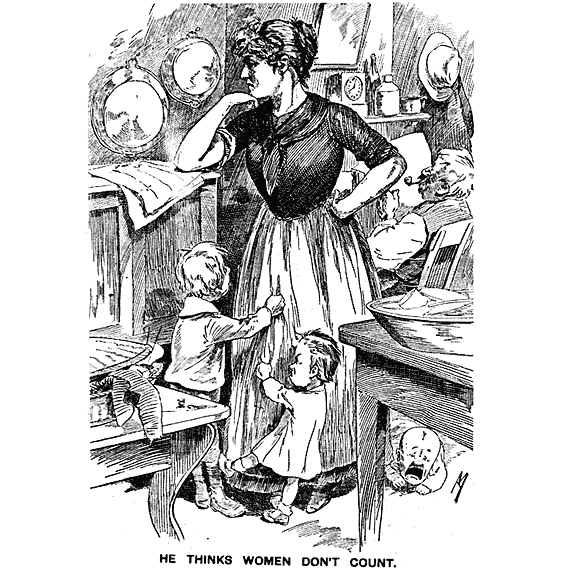
As the maid, Hannah, says in Louisa May Alcott's Little Women (published in 1868). The illustration above is from the same era, from a magazine published in Melbourne, Australia - a bit of satire on the reformers' push for an eight hour work day.

Interestingly, Alcott's friend and neighbor, Ralph Waldo Emerson had this to say in 1870:

Housekeeping is not beautiful; it cheers and raises neither the husband, the wife, nor the child; neither the host nor the guest; it oppresses women. A house kept to the end of prudence is laborious without joy; a house kept to the end of display is impossible to all but a few women, and their success is dearly bought.

An alternate title for this blog post could be "A Primer on Housework". My musings on this were prompted by a number of things - reading Hirshman's articles (not so much her book) and many thoughtful blog responses to the articles; reading Darla Shine's Happy Housewives and Caitlin Flanagan's To Hell with All That, and a bunch of research on 19th century housewives and prescriptive (or advice) literature that I did for a part-time job.

I am actually grateful that Linda Hirshman brought up housework again. Feminists seem to address it periodically, then forget about it until the next time a discussion of family responsibilities (especially child care) and the consequences of having a parent working full-time for household work comes up again. Arlie Russell Hochschild brought it to widespread (but not sustained) public attention in 1989, with the publication of The Second Shift, but in case you'd like to read more, check this other stuff out.

The following three fascinating blog discussions were prompted by Hirshman's "Homeward Bound" in the American Prospect (republished by AlterNet) last fall & winter, especially by Hirshman's discussion of the "domestic glass ceiling":

The Happy Feminist, On Valuing Housework

Be a Bitch about Housework - see many comments, by Bitch Ph.D.

The Domestic Glass Ceiling, by Half Changed World

____________________

Now going back in time, from before The Second Shift:

Life Sentence: The Politics of Housework
, by Debbie Taylor, from a 1988 issue of The New Internationalist devoted to housework.

Ann Oakley's books on housework and housewives, published in 1974. Her website doesn't provide page links - go to Publications, then Non-fiction, and then you can click on extracts from Housewife and The Sociology of Housework.

The Politics of Housework, by Pat Mainardi, 1970 - classic feminist essay. And funny. Very funny.

Housework in Late 19th Century America, by Steven Mintz and the complementary More Work for Mother, by Ruth Schwartz Cowan

Although I enjoy living in clean, well-appointed surroundings, I like writing, reading, and even mowing the lawn (with our reel mower, no less!) a lot better. We don't live in squalor, and luckily I have a high tolerance for clutter and dog hair, and little interest in what anyone outside my family thinks about this. Interestingly, I don't mind cleaning other people's stuff nearly as much as our own -- I greatly enjoyed and recommend Other People's Dirt: A Housecleaner's Adventures from Cape Cod to Kyoto, by Louise Rafkin for a fun read on zen & housekeeping, what your house tells your cleaning service about your lifestyle and personality, and some of the bizarre standards some women feel compelled to uphold.

Sunday, September 03, 2006

Get to Work: Book Review

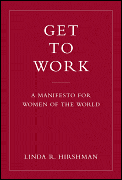
Get to Work: A Manifesto for Women of the World, by Linda R. Hirshman, starts out well enough:

If Betty Friedan had lived just a little longer. We are about to restart the revolution. But now we have to do it without her.
(From the first sentences of Get to Work - henceforth abbreviated as GTW, which is dedicated "In memory of Betty Friedan, Author, in 1963, of The Feminine Mystique".)

I've already written at length about Hirshman's articles (see Over-Educated Stay-at-Home Moms Made Feminism Fail, Hirshman and Feminism Again, Addressing the Issues, and Civil Discourse or Refreshing Honesty?), so I was prepared to be irritated by some portions of her book. I didn't expect to find a bunch of shoddy mistakes in it, though. Frankly, I expected better from a retired university professor and lawyer. I'm guessing that the speed with which GTW was written and published may account for some of its flaws.

Get to Work was a book of sound bites, with some good ideas buried underneath, well larded with a mishmash of personal opinion. As I said in my last "On My Nightstand" post, for a hardcover costing $19.95, it's pretty slim - including the seven pages of "Sources", GTW totals only 101 pages. This does make for quick reading, however. And I do like the cover a lot, which is rather classy, with its dark red background (which goes well with manifesto, though I don't see every woman in the US ever having this little red book in her bag) and its no nonsense design.

Hirshman's first thesis is that "For all its achievements, feminism cannot make more progress, private or public, until it turns its spotlight on the family" (GTW, p. 2).

Now this is something with which I wholeheartedly agree (see my review of Friedan's The Second Stage, Motherhood Discrimination or Special Privileges for Breeders?, and Crystal Eastman's wonderful article, written in 1920 after women in the US won the right to vote).

How
exactly feminists should turn their spotlight on the family - and how and where we should fight to change things, in both the public & private spheres - well, this is where Hirshman differs from me, and from many other feminists - so radically, and yet so paradoxically conservatively. But more on this later.

Hirshman's problems with educated women "opting out" of the paying workforce include the following points (summarized in my own words):

  • - Women at home don't (and cannot) fully use their capabilities (i.e., they are "unfulfilled")
  • - This at-home status makes them dependent on their husbands - especially economically, but also socially and in terms in decision-making and bargaining power
  • - Female talent is lost from the public world ("to the private world of laundry and kissing boo-boos" as Hirshman puts it)
  • - The ruling class (sociopolitical movers & shakers) continues to be overwhelmingly male
  • - All of the above sends the US in the wrong direction, or generally does more harm than good to our society

Hirshman's prescription for the above are her rules, or her "Strategic Plan to Get to Work" (summarized, as with the above points, with my own comments):

  • - Don't study art (or anything else where you can't make enough money to live on)
  • - Never quit a job unless you have another one (don't be unemployed!)
  • - Never know when you're out of milk (i.e., don't take charge of household tasks)
  • - Consider a "reproductive strike" (just have one kid, maybe, definitely no more)
  • - Get the government you deserve (vote, dammit, and vote appropriately)

Interestingly, "marry down" isn't listed in the prescriptive rules here, as it was in Hirshman's earlier articles. I see on her blog she has altered this rule to "don't marry a jerk", which is advice that’s hard to dispute.

It is unfortunate that so much of the internet reaction to Hirshman's ideas has been in the form of knee-jerk reactions and/or personal slander. Both Hirshman and some of her critics have armored themselves in impregnable (no pun intended!) self-righteousness, from whence they fire off personal potshots - completely irrelevant to the issues above – with sneering abandon. Of course some tired conservative critics yet again pulled "feminazi" out, but I was also dismayed to see that Hirshman wasn't above throwing a reference to "Mommy nazis" (p. 29, GTW) into her book.

Judith Stadtman Tucker's article, entitled Everybody Hates Linda, and a more recent review of GTW, Reviving the Feminist Mystique, stand in marked contrast to the unthinking reactions, along with most of the blogs that I linked to in my previous posts about Hirshman. Some of Hirshman's points and some of her strategic rules are genuinely worthy of thought and further discussion, and I've seen a lot of this recently at places like MomsRising and the Mothers Movement Online (although Hirshman dismisses the latter as "a good source for what passes for feminist activism on the family", p. 97, GTW).

But back to the book. Hirshman has decided than the ideology celebrating personal choice is a major player in modern feminism's failures, and she describes it at some length:

"Choice feminism", the shadowy remnant of the original movement, tells women that their choices, everyone's choices, the incredibly constrained "choices" they made, are good choices. Everyone says if feminism failed it was because it was too radical. But we know - and surely the real radical, Betty Friedan, knew - that it wasn't because feminism was too radical. It was because feminism was not radical enough (pp. 1-2 GTW, bold emphasis mine).

"Choice" is the weasel word, and it is legitimated, especially for women who consider themselves liberals, because it's been adopted by the feminist movement. Even the most empowered women do not see how narrow their options are at the moment of "choice" (p. 16, GTW, bold emphasis mine again).

"...feminism has actively encouraged women to run from a fight by embracing any decision a woman makes as a feminist act. I have dubbed this watered-down version of feminism choice feminism" (pp. 17-18, GTW).

"The choice is a false one, based on the realities of a half-revolutionized society. Once we recognize that, we can admit that the tools feminism offered women to escape the dilemma have failed. The book is an effort to try a different approach. It is time for a new radicalism (p. 25, GTW, bold emphasis mine).

Now on the one hand (as in the emphasized passages above), Hirshman acknowledges that women's choices about working and staying home with children are incredibly constrained. Or false, even. She acknowledges that the high cost of daycare (and I would add that high quality daycare or daycare for any kind of special needs costs even more) plays a role in many middle class mothers' decisions to stay home. Yet instead of promoting real choice, Hirshman opts for staying with the WOH/SAH dichotomy that our economy presently dictates, passing off current feminist calls (and Friedan's passionate arguments in The Second Stage) to "restructure the architecture of the workplace" as the "same old public day-care business that has gone nowhere since 1972", which she argues is merely a ruse to "accommodate women in their role as caretaker of the patriarchal family" (p. 6, GTW). Hirshman goes on to state that "Even in 2006, NOW's “family” initiative is all about building caring coalitions and funding child care and family leave in the public sphere rather than taking on the inequality where it lives" (pp. 22-23, GTW).

Personally, I think that restructuring both the family (dividing household and childcare tasks more evenly) and the workplace (to be more "family- friendly") is much more radical than Hirshman's suggestions, which leave the corporate underpinnings that devalue the private sphere totally unchanged. In fact, encouraging upper-class parents to employ lower-class women to care for their children and clean their houses strikes me as downright conservative.

When challenged by many who say that work in the public sphere is overrated (especially if it is not an economic necessity), Hirshman huffs that "just because work isn't as wonderful as people fantasized does not mean it isn't usually the best alternative available" (p. 15, GTW), and that "Working in the market economy has many rewards - of power, honor, money, exercise of capacities, and so on (p. 16, GTW). She adds that "it seems extremely unlikely that all the jobs in the public world are soul-destroying tyrannies or that all home life is a bucolic paradise" (p. 79, GTW), which is undeniable. But the reverse appears equally undeniable to me.

And what about all of the mothers who sequence (move in and out of the workforce), or work part-time, you ask? Well, you'd have to consult one of the books in my footnote for that kind of subtlety or real analysis. What about the influence of the media on how we perceive mothers? Hirshman mentions "the new momism", but apparently she didn't think that The Mommy Myth: The Idealization of Motherhood and How It Has Undermined Women, by Susan Douglas and Meredith Williams, deserved the same kind of acknowledgement that Nora Ephron's Heartburn ("Where's the butter?") did in her sources.

Although Hirshman does encourage women to demand gender equality at home, her opinion of anyone - male or female - who chooses to engage in childcare, housework, or any other unpaid labor at the expense of paid employment is very clear. It taints the book with an elitism that overshadows the real and important issues of gender inequality that she raises. Stay-at-home dads, whom she discounts as a minor statistical blip (instead of a genuine trend linked to greater male participation in housework and childcare) are denigrated as "Mr. Mom", which is a label that I thought went out with the 80's.

It is Hirshman's characterization of stay-at-home mothers, of course, that raised the most ire on the internet, and that was probably the deciding factor in bringing Hirshman's work to popular media attention (and a book contract). Not only does Hirshman continue to perpetuate a rigid and demonstrably false* dichotomy between SAH/WOH mothers in GTW, but she goes to great lengths to belittle mothers who "choose" to stay home. These women are never referred to as mothers or even as women in GTW, but are consistently labeled "moms", "the mommy bunch", "homebodies", and once, memorably, as "a kind of miniaturist in the business of life" (p. 17, GTW). In contrast, women with paying jobs are usually lauded as "workingwomen".

Not content with merely labeling, Hirshman goes on to caricature and objectify stay-at-home mothers in manner that only Michael Noer could come close to approximating:

By any measure, a life of housework and child care does not meet these standards for a good human life (p. 33, GTW).

Both my interviews and the public debate reflect that women who drop out of the public world demonstrate a singular indifference to the larger society (p. 38, GTW).

When they write to me, the homebodies, like the merry maid in the treetops with NPR on her Ipod and a letter to her congressman in her overalls, paint a romantic picture of flourishing in the domestic sphere (p. 78, GTW).

...is not all this biking and tree climbing a bit too much of the inner child for any normal adult? (p. 34, GTW).

[in reference to traditional gender roles vs. modern sah-moms' choices]...The chains just transmuted from golden links into the bonds of the invisible fence, like the one that people use to confine their dogs to the yard. (p. 43, GTW)

Hirshman's descriptions of stay-at-home mothers appear to come from a variety of media accounts: Judith Warner's Perfect Madness, her sampling of blogs and message boards, her survey of the New York Times' Style section brides, and Betty Friedan's The Feminine Mystique. It is hardly surprising that such cherry-picking produces a decidedly skewed result that does little to inform us about how fulfilling women that are not officially employed find their lives, their use of their education or talents, and their personal power, freedom, or economic dependence. But from the way Hirshman talks about these women, it doesn't appear that she believes that they deserve feminism's rewards, anyway.


As I read GTW, I couldn't help thinking of Betty Friedan's description of "the feminist mystique" (as opposed to the "the feminine mystique") in The Second Stage. Friedan describes "the feminist mystique" as some feminists' misguided and extreme attempts to be as different from the idealized housewives of the 50's and 60's (and often, their own mothers' life experiences) as possible, which she saw as ultimately damaging to feminism. No wonder that despite dedicating GTW to Friedan, Hirshman gripes that The Second Stage is both "dispirited" and "full of useless, grandiose, and wishful rhetoric" (p. 21, GTW). I guess it won't come as a great surprise to many readers that I found The Second Stage inspiring and surprisingly relevant today. I also thought The Second Stage was a great deal less pretentious than Get to Work, which included an unfortunate soupçon of philosophy and Plato in support of Hirshman's opinions about moral relativism, the right kind of values, and what constitutes a good life.

A few final irritating details that Hirshman and/or an editor should have caught: “The wonderful description of managing your husband’s housekeeping comes from the Blog Bitch PhD:” (p. 97, GTW) has the wrong hyperlink. The link should take you to My Radical Married Feminist Manifesto, not a discussion of South Dakota's abortion ban (and in case you’re confused, the blog’s title is actually Bitch PhD).

"There’s even a communal, bisexual, universally faithless monkey, the bonobo. Female bonobo polygamous” (p. 77, GTW). Bonobos are chimpanzees. Not monkeys. Yes, there is a difference, and it is not a minor one. And it is just weird to talk about bonobo fidelity in this context. The whole part on Evolutionary Psychology in GTW is just weird and an over simplified "strawmonkey". For a serious look at primate “fidelity” and evolutionary biology, check out Barbara Smuts' books or Frans de Waals' essays on bonobos.

And what is it with these non-fiction, supposedly serious books without indices? Are publishers trying to make it harder for readers to find the sections or quotes that interest them? Or do the authors and publishers just assume that once a book has been read, it’s immediately forgotten, never to be referred to again?

A lot of people have compared Linda Hirshman to Caitlin Flanagan (most notably Katha Pollitt), mainly because of their extremist views and propensity for snide remarks. When it comes to the books themselves, I actually found To Hell With All That rather enjoyable (see here), although I disagreed with Flanagan on many issues. If I owned Get to Work, on the other hand, I'd have to file it next to Darla Shine's Happy Housewives on my bookshelf, as another catchpenny classic in the sad tradition of self-serving, grandiose advice literature that purports to empower women and improve their lives.

*see Miriam Pesowitz's well-researched book, The Truth Behind the Mommy Wars. Strangely, Hirshman frequently denigrates Peskowitz personally, while totally ignoring her book, which addresses these topics in great detail. Peskowitz does not appear in Hirshman's list of "Sources" - nor do Ann Crittenden and Arlie Russell Hoschschild, whom have also written thoughtfully (and done much better research) concerning work-family balance and the processes of decision making on these issues.

Tags:, , , , , , , , ,

Thursday, August 17, 2006

Class in Mommy Wars and Feminist Carnival XXI


Journalist Susan Nielson has a refreshing take on the mommy wars, highlighted here in Salon's Broadsheet, along with an interesting paper by Michael Selmi and Naomi Cahn in Duke University's Journal of Gender Law & Policy.

Also, the 21st Carnival of Feminists is now up at Being Amber Rhea. Women and technology, sex positive feminism and defining feminism, male feminists and allies, and body image are featured topics. And there's a podcast!

Friday, July 21, 2006

The Second Stage: Book Review

The future of the family is
an overriding feminist issue.
~ Betty Friedan, on page 73
of The Second Stage

The Second Stage, written by Betty Friedan, was first published in 1981 - twenty-five years ago. This was the year after Reagan was elected. I was 18 and had just voted for the first time (and not for Reagan). This was also the beginning of the end of the fight for the ERA, as Friedan laments in her often overlooked and occasionally vilified book on what she perceived as the next stage of feminist "evolution", or the most important issues facing the women's movement that she helped found in the 60's with her publication of The Feminine Mystique.

Reading this in 2006 gave me a big dose of that "history repeats itself" feeling. In addition to critiquing what she saw as some of the excesses of feminism (which she called "the feminist mystique", as opposed to the "feminine mystique"), Friedan also examined Reagan-era politics and their relationship to women's emerging roles and issues. The similarities to the last six years of Bush politics are striking.

And Friedan seems positively prescient when she looks at what is now termed "work-life balance", child care, flexible work, maternity and paternity leave, and the danger that the right wing would claim "the family" and "family values" if feminists didn't address the problems engendered by their own revolution:

But what about the family work? The responsibility that used to be the woman's, in the home and family, as the man's duty was earning the money, out in the real world? How are we to put a value on family work? What is it really worth, compared to that other money-earning kind of work? How long will she keep doing it, by herself, if it's not valued, or shared?

....Still, the sophisticates who shrug off all this hysteria about the family as sentimental cant betray their own blind spot. We have to break through the cant and the blind spot and deal with the problems of the family now, which neither feminists nor antifeminists can avoid in real life (p. 70).

Why, with the majority of mothers now working, haven't feminists put as much energy into the battle for a multifaceted approach to child care - developing new options, using services and funds from a variety of sources...demanding tax incentives and innovations like a voucher system - as they have put into the battles against sex discrimination or for abortion?....There was, in fact, cold silence, or even open annoyance, in various feminist ranks in response to our appeal, in the fall of '79, that the women's movement come to grips with the practical problems of the family which our move to equality entails (p. 73).

It seems like it has only been in the last ten years (or less) that most feminists have really taken motherhood and its problems seriously again - as shown by the many websites and books discussing the two and how they've proliferated in the last decade.

Note the new page on Mothers and Caregivers Economic Rights on NOW's website, for instance, and the founding of the Mothers Movement Online in 2003. Then there's this year's Momsrising.org and the publication of The Motherhood Manifesto, by Joan Blades and Kristin Rowe-Finkbeiner. The recent frenzy of discussion on "the mommy wars" can even be seen as evidence of increased attention on what Friedan characterized as feminism's failure and blind-spot:

To the degree that feminists collude in assuming an inevitable, unbridgeable antagonism between women's equality and the family, they make it a self-fulfilling prophecy (p. 74).

Equality in jobs, without taking into account family, leaves women doubly burdened. And equality in the family isn't real for women if it is isolated from economic measures of worth and survival in the world....Part of the problem comes from the lack of real economic measures or political attention to the previously private woman's work, in home and family, an irreducible minimum of which is necessary for human and society's survival...(p. 80)


The women's movement did not fail in the battle for equality. Our failure was our blind spot about the family. It was our own extreme of reaction against that wife-mother role: that devotional dependence on men and nurture of children and housewife service which has been and still is the source of power and status and identity, purpose and self-worth and economic security for so many women - even if it is not all that secure any more (p. 156).

There were some passages that I didn't find particularly enlightening or interesting (such as Friedan's discussion of Alpha vs. Beta politics, and the look at cadets in the newly integrated West Point), but overall I found
The Second Stage a surprisingly timely and interesting work. I was a bit uncomfortable with her continued use of "evolution" (with its connotation of directed evolution towards progressive ends, as opposed to the more biological or modern anthropological use of the term), but that's minor in the scheme of things.

The parts of the book for which some feminists scorned Friedan for betraying feminism, I saw as again, relatively minor asides. She basically quibbled with the second wave feminists' focus on sexual identity, sexual discrimination, "rape culture", and abortion at the expense of economic inequality for women in families. Friedan never actually comes out and says the former are not important, but she does repeatedly argue against the polarization of politics that emphasizing these issues may incur. I'm not sure if that's a good or complete explanation for changes in feminism and national politics in the last 25 years, but it's interesting to ponder. Friedan herself sees this polarization at least partially as an over-reaction to the "feminine mystique", where the feminists wanted to get as far away from their housewife roots as possible.

While reading more about the transition from second wave to third wave (but "second stage"?) feminism, I ran across this interesting article & interview - The End of Herstory, by Kay S. Hymowitz - published in 2002, that explores some of the generational differences (in feminism, and popular culture as a whole) that I straddle. Although Hirshman is mentioned (as one of the old-style "radical" feminists), I thought it was interesting that Friedan's Second Stage was not - although Hymowitz does describe a "Feminist mystique" and "feminist career mystique". I don't think Hymowitz could still say that "Motherhood too interests orthodox Feminists only insofar as it overturns bourgeois norms."

Monday, July 17, 2006

Now We Can Begin...Eighty-Six Years Later


It never ceases to amaze me when something written generations ago seems as fresh and relevant today as it was for our grandmothers. I've added the bold emphasis, for passages I think are relevant to current debates.

What, then, is "the matter with women"? What is the problem of women's freedom? It seems to me to be this: how to arrange the world so that women can be human beings, with a chance to exercise their infinitely varied gifts in infinitely varied ways, instead of being destined by the accident of their sex to one field of activity - housework and child-raising.

And second, if and when they choose housework and child-raising, to have that occupation recognized by the world as work, requiring a definite economic reward and not merely entitling the performer to be dependent on some man.

...It must be womanly as well as manly to earn your own living, to stand on your own feet. And it must be manly as well as womanly to know how to cook and sew and clean and take care of yourself in the ordinary exigencies of life. I need not add that the second part of this revolution will be more passionately resisted than the first. Men will not give up their privilege of helplessness without a struggle. The average man has a carefully cultivated ignorance about household matters -- from what to do with the crumbs to the grocer's telephone number -- a sort of cheerful inefficiency which protects him better than the reputation for having a violent temper. It was his mother's fault in the beginning, but even as a boy he was quick to see how a general reputation for being "no good around the house" would serve him throughout life, and half-consciously he began to cultivate that helplessness until today it is the despair of feminist wives.

...Cooperative schemes and electrical devices will simplify the business of homemaking, but they will not get rid of it entirely. As far as we can see ahead people will always want homes, and a happy home cannot be had without a certain amount of rather monotonous work and responsibility. How can we change the nature of man so that he will honorably share that work and responsibility and thus make the homemaking enterprise a song instead of a burden? Most assuredly not by laws or revolutionary decrees. Perhaps we must cultivate or simulate a little of that highly prized helplessness ourselves. But fundamentally it is a problem of education, of early training -- we must bring up feminist sons.

...If the feminist program goes to pieces on the arrival of the first baby, it is false and useless. For ninety-nine out of every hundred women want children, and seventy-five out of every hundred want to take care of their own children, or at any rate so closely superintend their care as to make any other full-time occupation impossible for at least ten or fifteen years. Is there any such thing then as freedom of choice in occupation for women? And is not the family the inevitable economic unit and woman's individual economic independence, at least during that period, out of the question?

...But is there any way of insuring a woman's economic independence while child-raising is her chosen occupation? Or must she sink into that dependent state from which, as we all know, it is so hard to rise again? That brings us to the fourth feature of our program -- motherhood endowment. It seems that the only way we can keep mothers free, at least in a capitalist society, is by the establishment of a principle that the occupation of raising children is peculiarly and directly a service to society, and that the mother upon whom the necessity and privilege of performing this service naturally falls is entitled to an adequate economic reward from the political government. It is idle to talk of real economic independence for women unless this principle is accepted. But with a generous endowment of motherhood provided by legislation, with all laws against voluntary motherhood and education in its methods repealed*, with the feminist ideal of education accepted in home and school, and with all special barriers removed in every field of human activity, there is no reason why woman should not become almost a human thing.
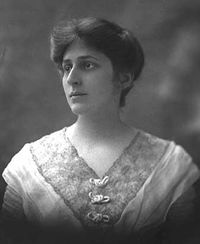
~ Crystal Eastman, shown above, writing in 1920, in The Liberator, (read the complete text of "Now We Can Begin" here).

The second wave of feminism made some amazing progress in the 60's and the 70's, but it is also more than a little shocking to realize how clearly some of feminism's basic challenges were articulated long before that, and how little real progress has been made in these areas.

*when she speaks of "voluntary motherhood and education in its method", Eastman is referring to birth control - involuntary motherhood being what happens without access or educated use of contraception. Considering that I recently read that about a quarter of all pregnancies are unplanned, we haven't come such a long way here, either.

Friday, July 14, 2006

Civil Discourse or Refreshing Honesty?

Clearly, a lot of the people who take issue with Linda Hirshman (see previous two posts) object to her tone and style as much as to the content of her arguments. As I was thinking about this (and the difference between blog commentary and letters to the editor, or face to face debate), I got around to reading the rest of the 18th Carnival of Feminists, particularly this interesting post: Thoughts on blogging, hostility and feminist dialogue, by Winter at Mind the Gap!

Although I'm sure a lot of the vitriolic commentary left on blogs (or online articles, like Salon or many online newspapers) is not particularly productive, I usually find it some of it entertaining, and I guess I'd rather have trolls than censorship. It is ironic that Linda Hirshman decries all the pejorative e-mails her public pieces have attracted at the same time that she celebrates her own caustic approach, mocking those that plaintively ask if we can't just support each other as mothers making choices. Or "choices", as Ampersand might put it.

Wednesday, July 12, 2006

Hirshman and Feminism Again

Well, I still haven't read Linda Hirshman's Get to Work: A Manifesto for Women of the World, so I really can't blog about it. I'm on the library waiting list for it (and I didn't even request that they buy it, as I prefer to only do that for books I really think are useful to more people, such as Miriam Peskowitz's The Truth Behind the Mommy Wars), so I don't have to give Hirshman any of my money to read it.

The latest round of articles (both on the web and in the print media) on Hirshman is basically a reaction to her inflammatory, self-promoting article "Unleashing the Wrath of Stay-at-Home Moms" in last month's Washington Post. As you might expect (see my response to her American Prospect article here), she made some statements with which I vehemently disagreed. And although I learned my lesson about blogging about a book before reading it with To Hell with All That, this doesn't mean that I can't comment on Hirshman's Opinion piece. So let the fisking begin:

The mommyblogs vilified me as a single, childless, bitter loser; the feminists claimed women weren't quitting; and a chorus of other voices didn't care what I said -- criticizing women just wasn't allowed. A handful of political thinkers did concede that I had raised the biggest issue left for feminism -- justice in the family -- but it was definitely a minority report.

Talk about a gross exaggeration. Some commenters on some blogs certainly speculated that someone who used such vituperative language about mothers must not be one herself, but none of the other bloggers that I read (see the many listed in my previous blog post on Hirshman) said anything like that. Note Hirshman's use of "mommyblogs" here - she might as well say, "Now, now, little mommies, you just leave this heavy thinking to the philosopher here." Please also note that the article that she touts as evidence of how maligned she has been - Everybody Hates Linda - is actually a pretty thoughtful piece that "positively applauds" some of Hirshman's ideas - while not shirking from a dispassionate analysis of its flaws.

The aggressive domesticity is not coming only from a bunch of women who can't manage all the demands on their time. Time and again, when I could identify the sources of the most rabid criticism and Google them, male and female, they had fundamentalist religious stuff on their Web sites or in the involuntary biographies that Google makes possible.

Once again, a ridiculous exaggeration. Very few of the many blogs that I read had religious ties, let alone fundamentalist ones. On the contrary, most of the blog criticism that I read (and enjoyed) came from overtly liberal and very a-religious sites. Well, maybe Linda found some secret cache of rabid bloggers that neither Technorati nor Google Blog could uncover.

Much worse than the roofing-and-barfing and salvation crowds, though, were the relativists, who criticized me for trying to give feminism some context and boundaries.

Well, since Linda has effectively discounted anyone who has written about the mundane aspects of life, and anyone who admits to any religious affiliation (please note that the latter does not include me), now she goes after the relativists. Damn all you compromisers, anyway! Remember, only Linda is qualified to provide the (ridiculously exaggerated) context for feminism, and its new more stringent boundaries.

These so-called liberals and feminists, who were once in the forefront of making social change, declared that people could no longer suggest that women should change their lives. A generation ago, such liberals included Betty Friedan, who called staying at home "the problem that has no name," and Alix Kates Shulman, who suggested that women should take on the problem by refusing to do 70 percent of the housework.

Apparently, Linda hasn't read anything that Betty Friedan or Alix Kates Shulman wrote after the 1970's. I suggest that she read Friedan's The Second Stage or Shulman's Drinking the Rain to see how more thoughtful second wave feminists matured. Wait, though - I have to warn you, Shulman talks about her roof and domestic pleasures at great length. Mind you, I am not a supporter of a domestic glass ceiling, I just don't think that Hirshman's solutions are workable or even reasonable.

Well. There was no chance that I was going to shut up. I'm retired. If I'm not going to raise hard questions for women, who will?

Why, Linda? Why? Why on earth did you retire if working at a law firm or as a philosophy professor was for the greater good?

And Katha Pollitt, Joan Blades, and Kristin Rowe-Finkbeiner are my latest choices for people raising hard questions for women. Or the (yeah, I know, those democratic unwashed masses from the internet again) feminist and "mommy" bloggers out there (see blog roll on right side of screen). Which reminds me, I forgot to link to the 18th Carnival of Feminists. Don't forget to check out Redneck Mother's post in there.

I guess working women are too busy at work to blog about their lives and are already on their way to their jobs when "Good Morning America" puts me on at 8 a.m. Maybe a little scared? They're doing what beleaguered, overworked people do. They're publishing a manifesto.

Gee, a lot of the women I know with jobs outside the house have a lot more time to blog than those at home. Maybe the reason that they aren't showering Linda with praise is because they don't like her argument? Maybe they resent not having more choices and flexibility?

And Linda - we already have a manifesto. Check out The Motherhood Manifesto: What America's Moms Want - and What to Do About It and momsrising.org. I think there's a lot there that many corporate workers (not just parents) can appreciate. Yeah, it's got choice, but that doesn't mean it doesn't also have boundaries.

_________________________________________

Some more responses: Taking the Political Personally, from Crooked Timber - note many fascinating responses to his question of "why it is that this is such an emotive topic?"

The Personal Is (Still) Political, at Half Changed World - on how our personal choices (about feminism, in particular) can change the world

A Working Girl Can Win, in Slate, by Meghan O'Rourke - on some of the points that Hirshman makes that may be overlooked in the brouhaha

Understanding Betty Friedan: Why Linda Hirshman Doesn't
, in Slate, by Emily Bazelon - on some of Hirshman's mistakes and the mis-charaterization of an important second wave feminist

Do We Trust Mothers? and Spreadin Love - and well, many other cogent posts by 11D. Just read all of her blog, it's worth it.

One of my favorite articles is Mommy Wars, Round 587, by Katha Pollitt in The Nation - it compares Hirshman and Caitlin Flanagan, who are so similar in their obnoxious self-promotion and self-righteousness. I think I'll be buying Pollitt's new book, Virginity or Death!

Katha Pollitt on Flanagan and Hirshman, on Alas (A Blog) - wonderful comments, including some from Pollitt.

and Echidne of the Snakes - again, check out the comments. Certainly not from a bunch of religious wingnuts.

and edited on 7/14 to add: Hirshman and the Value of Working, Round Two, by Leslie Morgan Steiner - many comments, but I didn't see anything really new jump out.

Wednesday, June 28, 2006

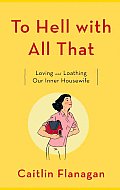
To Hell with All That: Book Review

Alternate blog post title: Seduced by Caitlin Flanagan

To Hell with All That: Loving and Loathing Our Inner Housewife, by Caitlin Flanagan, has already been reviewed so many times - and the author has given so many interviews, some of them (like the Colbert Report) so outrageous - that I hardly thought it was necessary to read the actual book.

That'll teach me to judge a book by its press:
To Hell with All That
was not at all what I expected.

(Next thing you know I'll read Linda R. Hirshman's Get to Work: A Manifesto for Women of the World and learn that Linda really loves scrubbing toilets and changing diapers).

I expected an anti-feminist diatribe against working mothers. Perhaps a more eloquent version of Kate O'Beirne's Women Who Make the World Worse: And How Their Radical Feminist Assault Is Ruining Our Schools, Families, Military, and Sports, which I was embarrassed to be seen checking out of the library, and returned in disgust after reading a few ridiculous chapters.

What I found was a collection of essays - some autobiographical, some on current social mores (Martha Stewart and modern weddings) that I genuinely enjoyed. It is true that a few sentences made me choke on my coffee, provoking the same WTF? response that I had when I saw the infamous Colbert Report clip, but there were many passages where I nodded my head in agreement or wrote "true" in the margins. As I write this, I realize that I'm saying much of what Jen Lawrence said in her review in LiteraryMama - but that's pretty much how it happened, and I am going to go on and fisk a few things I haven't seen in the other reviews.

from the Preface:
Writing honestly about these issues in the national press has been difficult because it required challenging certain articles of faith that comprise what the current American feminist agenda requires us to believe about womanhood. (p. xviii)

I've considered myself a feminist for at least the last 25 years, so I'm not sure how I completely missed the required "articles of faith". I thought that it was fairly impossible to get a group of feminists to agree on much, let alone an American agenda that includes all of the points that Flanagan lists. Her points are a caricature of some radical feminist ideas. All that's missing is a reference to bra burning. Linda R. Hirshman, now, probably agrees with many of the points, but she's not exactly a mainstream feminist.

The first article of faith:
Girls do not have a natural interest in homemaking. (p. xviii)

Since I've never had much of an interest in homemaking, my first reaction was "Am I not a woman?" And what does she mean by "natural"? That there's a biological basis for females doing housework? Then why is it so easily overcome by messy housewives? Women wouldn't ever hire housekeepers like Caitlin does if it was in our genes, they'd have to do themselves. Meh, I'm just suspicious of how many cultural things are attributed to nature. But onward to the rest of the book.

from The Wifely Duty (which I think could also be called Sex Is an Obligation Once You're Married):
The reason abortion rights hold such a sanctified position in American political life is that they are a critical component of the yuppie program for maximum personal sexual pleasure. (p. 22)

This was one of those sentences that made me choke. Maybe this would be true if contraceptives were not available, but today? Nah, can't see it. And personally, I don't see the overwhelming lack of sex within marriage that Caitlin does. Maybe it has something to do with our different circles of friends. She does note that "Nowadays American parents of a certain social class seem squeaky-clean, high-achieving, flush with cash, relatively exhausted, obsessed with their children, and somehow - how to pinpoint this? - undersexed." (p. 33). It certainly seems like Caitlin Flanagan is in the same neurotic social circles that Judith Warner is. I guess that explains a lot.

I did enjoy her discussion of Marabel Morgan's The Total Woman, which I read myself right after reading Darla Shine's Happy Housewives, and I was happy to hear that Caitlin was "not entirely incapable of good old-fashioned feminist rage" about "The notion that even educated middle-class American women had to put out in order to get a damn refrigerator" (p. 29).

from Housewife Confidential:
The notion of a domestic life that purrs along, with routines and order and carefully delineated standards, is endlessly appealing to me. It is also quite foreign, because I am not a housewife. I am an "at-home mother," and the difference between the two is vast. (p. 38)

Now I was very interested to see this, because a while back I pondered the difference between the two here in my blog. Apparently, in Caitlin's world, the major difference is economic: if you can afford to hire housekeeping help (or you just don't care about clean floors?), you get to be an "at-home mother" without the drudgery of housework.

I was fascinated by her paean to the Midwest (having lived in this part of the country for most of my life), but I have to say that her fantasy of a place where "most of life's difficulties could be handled with a combination of good humor and endurance" (p. 55) is just as much a myth as her characterization of growing up in the 60's:

...a bygone age, as remote and unrecoverable as Camelot: a world of good meals turned out in orderly fashion, of fevers cooled without a single frantic call to the pediatrician, of clothes mended and repaired and pressed back into useful service rather than discarded to the rag heap as soon as a button pops or a sleeve unravels. (p. 167-8).

Well, Camelot was pretty much a complete fantasy, wasn't it? But how hard is it really to learn to sew a button on, Caitlin? My husband does it occasionally, as do I. Maybe our skill is linked to our hardy Midwestern upbringing in the 60's, but I do think that someone whom is obviously intelligent and watches so much Martha Stewart could switch off the TV and take ten minutes figure this button thing out.

from A Necessary Person:
Children love the person who provides daily physical care to them in a singular and primal way - a way obviously designed by Nature herself to cleave child to mother and vice versa. (p. 65)

I've already commented on her use of natural with a small "n". Forgive me if I'm not impressed by Nature with a large "N" either. I think reading Sarah Blaffer Hrdy's Mother Nature: Maternal Instincts and How They Shape the Human Species provides a more realistic idea of the blood and gore and ambition and love and other emotions that characterize all mothers, from Susan Smith to Phyllis Schlafly.

from Drudges and Celebrities: The New Housekeeping
: I remember, during that time, knowing many girls whose mothers had discarded many things, giving up decent housekeeping, turfing out husbands, taking up weird pastimes....They were starting compost heaps in the backyard: moldering heaps of garbage, rich with worms and loamy rot....They would have hideous caches of broken eggshells and wet coffee grounds squirreled away on kitchen counters, waiting to be delivered to the compost heaps. (p. 143)

Oooh, she's got me there. Too bad Caitlin wasn't here two summers ago to see our experiment with vermiculture in the basement. However, despite my hideous cache on the kitchen counter (which I'll have to ask my friends if they've noticed, now), I do manage to comb my daughter's hair, and I don't wear batik. I absolutely hate twinsets, though, which Caitlin seems to favor. I do rather like tie-dye, but I still manage to shave my legs. Sometimes. Oh, and I haven't turfed out my husband, whom I've lived with for 23 years now.

from Clutter Warriors:
And so began one of the most important relationships in my life. My organizer, let us call her Sarah...(p. 163)

Give me a break. Your household organizer is one of the most important people in your life? Gah.

Something that I found endlessly interesting throughout this book is that Caitlin is (give a take a few months) the same age that I am - and my mother also returned to work full-time when I was 13 (Caitlin was 12 when her mother got a job after being home with her previously).

"Being home alone is stressful for a child," psychologist David Elkind has written and he's dead right. Just walking through the front door each afternoon to be met by the quiet gloom of the empty living room was depressing.... Afternoons alone in the house were often frightening. It did not help that I am a hysteric by nature.

Now maybe it was the result of living in a bucolic small town in Illinois, but I didn't find being home alone after school particularly stressful at that point. In fact, I reveled in the freedom to do whatever I wanted. The only time I was ever scared was while reading The Amityville Horror (and I'm fairly certain I would have been scared even if my parents had both been home while I was reading that).

from To Hell with All That
: And when I couldn't walk from the car to the doctor's office, he carried me. And if that's a traditional marriage, I'll take it. (p. 195)

This is a famous line that has already drawn scores of comments. My only comment: that's not traditional marriage, that's commitment, and the two are not necessarily the same.

So these are the kind of things that bugged me in To Hell with All That. I haven't really praised the parts that I liked much, although there were many. Several passages had me howling with laughter, and I chuckled at quite a few more. Her passages about cleaning out her parents' house were beautiful. They made me think about my parents' house (which I haven't had to clear yet, thank goodness), and my great-grandmother's kitchen tools, which I use fairly often, thinking of her. And how can I loathe a woman who uses the word elegiac so elegantly, no matter how misguided she is sometimes?

As I described the book to my husband (describing what little I knew about the author's personal life), however, I realized something interesting. Why didn't Caitlin change her name when she got married if she's such an ardent anti-feminist?