Showing posts with label anthropology. Show all posts

Saturday, January 08, 2011

Every Bone Tells a Story: Book Review


Every Bone Tells a Story: Hominin Discoveries, Deductions, and Debates, by Jill Rubalcaba and Peter Robertshaw

In general, archaeologists and paleoanthropologists don't do a great job of telling the public about their work. Their studies are so technologically and theoretically specialized today that it's difficult to convey all the relevant information to even a fairly well-read person, unless these people are willing to sit through several introductory lectures or classes in anthropology. And even then it can still be hard to describe the subtleties of current anthropological debates and translate the latest jargon (like hominin!*) to students....er, the general reader. It doesn't help that anthropologists aren't generally rewarded for making their passions clear to the public. It doesn't get them tenure, advance their research, or bring in grants, and writing for non-specialists is very, very different from the type of writing that anthropologists are trained to do in graduate school. Sadly, grad students and most anthropologists aren't awarded any points for creative writing, compelling dialogue, or evocative descriptions - or any of the other things that keep readers (especially children) turning the pages of a book.

Explaining anthropological research to the public is crucial if the field is going to continue to exist in times of economic hardship, however. Which partially explains why I was so excited to learn about Rubalcaba and Robertshaw's latest book when it was mentioned in the comments at Heavy Medal, the School Library Journal's blog on the current contenders for the Newbery.

Sadly, I had to request Every Bone Tells a Story from inter-library loan to read it. Only ten or so libraries in Michigan currently have it in their catalogs (and Ann Arbor isn't one of them! I suggested that they buy it). Maybe if it wins some more awards it will find its way to more libraries and into the hands of more kids and adults.

It's written for older kids through young adults, but like some of the other nonfiction contenders for this year's Newbery prize (such as Sugar Changed the World, by Marc Aronson and Marina Budhos, and They Called Themselves the KKK, by Susan Campbell Bartoletti), Every Bone is suitable for adults as well as kids. The writing style is simple and usually clear without being simplistic (with the exception of the section on the genetics of speech, and let's face it, mitochrondial DNA is difficult to explain clearly), and much of the information presented will be new and interesting to anyone interested in human evolution. Four sets of skeletal remains from different time periods are presented, with wonderful descriptions of their discovery, some good summaries of the deductions scientists have made that are based on these remains, and lively looks at the current debates swirling around them.

Because Every Bone Tells a Story is very well-written, I found myself wondering which author wrote which parts, but it was all very seamless, without any discernible differences in style. Perhaps Peter Robertshaw is one of those rare archaeologists with a gift for popular as well as academic prose, or maybe Jill Rubalcaba has the (also fairly rare) ability to imbue scientific discourse with human interest. At any rate, it was an enjoyable read, reminding me a lot of Mary Roach's nonfiction books (Stiff, Bonk, Spook, and Packing for Mars), which are funny, informative, compelling and memorable. It's a hard balance to find.

My only criticisms of this book are minor ones (i.e., not enough to warrant taking a star away from the 5 out of 5 I gave it on www.goodreads.com). I wish that one of the skeletons that they had featured was distinctively female, so prehistoric gender roles could have been addressed. Lapedo child could have been a girl, but we really can't tell. I think the Time Line at the back of the book should have been put in the front - it would help readers put the Turkana Boy, Lapedo Child, Kennewick Man, and the Iceman in an temporal/evolutionary context as the reader encountered each of them, instead of trying to fit them all together at the end.

Unfortunately, Every Bone was written and published right before Svanto Pååbo completed the latest  reconstruction and analysis of the Neandertal genome, which reversed earlier conclusions about ancient humans and Neandertals gene-mixing. The latest genetic analysis suggests that Euro-Asian populations may have interbred with Neandertals between 60,000 and 100,000 years ago, probably in the Middle East (see Nicholas Wade's article in the NYT from May 2010). It must have been frustrating for the authors to see this research appear so soon after their book came out, with its debate section on Lapedo Child that cited Pååbo's earlier suggestion that "Neandertals went extinct without contributing to our gene pool" (p. 79), yet their conclusion notes that research continues, and the bones' stories have just begun.


* Hominin is the new, rather unwieldy term used to classify humans, their ancestors, and closely related species, including the genus Homo and the genus Australopithecus. The Tribe Hominini does not include chimpanzees or gorillas. Hominid, which anthropologists previously used to describe humans and their ancestors, now includes chimpanzees and gorillas as part of the family Hominidae. Got it?


Tuesday, August 18, 2009

Until Our Hearts Are On the Ground

Here's the last book review that I've done in the last few years for a website that is no longer maintained (but that can still be accessed via the Wayback machine). The Association for Research on Mothering (ARM) holds fascinating conferences and publishes an incredible diversity of books on motherhood (this year's on blogging).

"Until Our Hearts Are On the Ground”: Aboriginal Mothering, Oppression, Resistance and Rebirth, edited by D. Memee Lavell-Harvard and Jeannette Corbiere Lavell, is an eye-opening and diverse collection of papers published by Demeter Press, the publishing division of York University's Association for Research on Mothering.

The book's title comes from a Cheyenne proverb:


“A nation is not conquered until the hearts of its women are on the ground. Then it is done, no matter how brave its warriors nor how strong their weapons.”

Until Our Hearts Are On the Ground's diversity is both its strength and a minor drawback. The multiple voices, different indigenous peoples, varied histories, and the personal experiences of motherhood that Lavell-Harvard and Lavell (mother and daughter editors) bring together are amazing, but the diversity is sometimes overwhelming. It can be difficult to switch gears between the different topics and styles of writing in the contributions. Lavell-Harvard and Lavell acknowledge this in the first paper ("Thunder Spirits: Reclaiming the Power of Our Grandmothers"), noting that "There is such a range of Aboriginal women's experiences existing somewhere between "traditional" and "modernized" that perhaps the only thing we do share is what Mihesuah calls a 'commonality of difference'"(p. 2).

They go on to eloquently and convincingly explain how:


"the historical persistence of our cultural difference generation after generation (despite the best assimilative efforts of both Church and State) is a sign of our strength and our resistance. That we have historically, and continually, mothered in a way that is "different" from the dominant culture, is not only empowering for our women, but is potentially empowering for all women (p. 3)."

Lavell and Lavell-Harvard do a skillful job of organizing the diverse works into four sections: one on pregnancy and becoming a mother, the ideology and practice of motherhood, the state's influence on motherhood, and literary representations of motherhood.. And the references and the endnotes are remarkable - there are scads of wonderful, intriguing sounding articles, books, and papers from the most obscure places in each article's references.


A few of the papers are written in an academic style that can be off-putting for those not accustomed to it. If you persevere, however, the insights into different cultures and social groups, and the historical understandings gained, are definitely worth a few obtuse paragraphs of sociology, medical anthropology, ethnohistory, or literary analysis. I learned something, or was moved, or came to a new appreciation for the strength that the mothers portrayed have shown in the face of incredible hardship in every single one of the papers in this book.


The seventeen papers include reflections on motherhood amongst the Anishnaabe (Ojibway) of Canada, cultural and personal implications of the medicalization of birth (among Anishnaabe and Mi'kmaq communities), a fascinating look at historic Haudenosaunee (Iroqouis) mothering (especially interesting for those studying non-patriarchal societies and/or gender equality) , and one Metis mother's powerful account of how traditional parenting skills programs made a difference in her life.


“Back to Basics” describes mothering, and the impact that grandmothers and aunts - also prominent in several of the earlier papers on Canada - have on children’s survival (especially from kwashiorkor) in urban Ghana. On my first look at the book, I thought that Africa was a far cry from Canada, and wondered how this piece could possibly fit in with the other papers, but the authors do show how colonization and various forms of oppression have had a similar effect on motherhood in many areas of Africa, North America, and Australia. Similarly, three papers on Aboriginal mothers in literature, including works by authors Leslie Marmon Silko, Louise Erdrich, and Nugi Garimara (aka Doris Pilkington, the author of Follow the Rabbit-Proof Fence) fit well in this book.


"Aboriginal Mothering: An Australian Perspective" provides an important look at "the Stolen Generation" (which many North Americans first heard about in the movie The Rabbit-Proof Fence), focusing on how women and families are re-connecting after the long period of cultural genocide that happened when children were taken by the Australian government in the years between 1905-1970. This paper is fittingly followed by a couple of papers on Canadian state child protection policies and indigenous mothers, the history and lingering effects of Canada's residential schools, and a short but revealing look at the impact of Canada's Indian Act and its context in colonization and oppression, authored by the editors.


As described on page 188, Jeannette Corbiere Lavell (one of the editors and co-author of "Aboriginal Women vs. Canada" ) was the first woman to challenge the section of the Indian Act's Section 12(1)(b), which was finally amended by Bill C-31 in 1985. As an American, I had heard the Canadian term "status Indian", but I was unfamiliar with the implications of how the Canadian Indian Act worked (and continues to work with its 1985 modifications). As Lavell and Lavell-Harvard describe,


"For well over a hundred years, beginning in the 1870s and continuing until as recently as 1985, under the provisions of section 12(1)(b), upon their entrance into marriage with a man not possessing Indian Status, the Canadian government stripped tens of thousands of Aboriginal women (and any subsequent children) of their Indian Status, and all the rights such status entailed including access to health care, education, and perhaps most importantly the right to live in their own homes and communities. Conversely, under the Act, not only did Indian men not lose status upon marriage to a non-aboriginal, their spouses gained status as did their children...Furthermore, since the extinguishment of Indian Status was irrevocable, many Aboriginal women were left without recourse in the even of domestic violence, divorce, or widowhood (p. 187)."

As Lavell and Lavell-Harvard point out, Bill C-31 (which restored Indian status to over 100,000 people)

"has simply created several new categories of Indian and only postponed the extinguishment of Indian status a couple of generations. While Lavell, and many other women like her, were reinstated as 6(1) Indians, her three children were classified as 6(2) Indians, which means their children, her grandchildren, will only be considered Indians should her children marry status Indians. Should her children marry non-Indians, her grandchildren will automatically be considered non-Indian. In a sad twist of fate, or perhaps a particularly ingenious governmental trick, Lavell's struggle for the right to marry whomever she pleases and still remain an Indian is currently being relived by her children" (p. 191).

This papers in this part of the book - the section titled "'Big Mother': The Role of the State in the Performance of Mothering" - are the most disturbing to read, but also the most illuminating.

I believe that most readers will come away from Until Our Hearts Are On the Ground with a deeper understanding of how history (and current government policies) affect families through their actions on mothers and mothering, as well an enduring admiration for the women who showed such strength in the past, and who continue to fight for their rights today. Until Our Hearts Are On the Ground also demonstrates the richness and diversity of Aboriginal motherhood, and should lay the idea that there is "one right way to mother" permanently to rest.


Friday, May 29, 2009

Catching Fire

Strangely enough, I have two very different books with the same title on my "to read" list right now:


Weird coincidence, eh?

And for a short review of some fiction for kids about archaeology, combining the two interests above - anthropology (Richard Wrangham's Catching Fire) and Young Adult fiction (Catching Fire is the not yet released sequel to Suzanne Collins' The Hunger Games) - check out my goodreads.com review of Reading the Bones, by Gina McMurchy-Barber. It's one of the only pieces of fiction that I've read (for adults or kids!) that deals with many of the issues that archaeologists face. Amateur collectors, the repatriation of Native remains and sacred objects, scientific goals, and homeowner's feelings about private property are mixed well with overly authoritarian adults, a rebellious pre-teen girl, and some suspense. I hope McMurchy-Barber writes another and that this book gets a little more press - it was hard to find!

Wednesday, February 04, 2009

Unblocking

Perhaps I took Reblock Yourself the Polly Frost Way! a little too seriously. I haven't blogged here since before Christmas.

Yes, most of my family did explore viral gastroenteritis in January. That's another excuse. I knew it was sweeping through my daughter's grade school. I suspected that it came on quite suddenly when we were at her school's Winter Carnival, when a nine year old a few people in front of us in line lost his dinner. At least his dad hadn't paid for that second piece of pizza yet.

And I've been busy shoveling snow. And putting plastic over our leaky windows. I'm glad to see the last of January.

I have been reading. Here are a few notes on what I've been reading since the beginning of the new year:

Don't Sleep, There Are Snakes: Life and Language in the Amazonian Jungle, by Daniel L. Everett

This was a truly interesting book, if a little disjointed. The author combines an autobiographical account of his work as a missionary and a linguist among a group of Indians in Brazil (the Pirahã) with some classic ethnography and musings on linguistics theory, philosophy, and religion.

The Pirahã are really different, both culturally and when it comes to language. If you want to read about about some people that think about life in a fundamentally different way, this is a good introduction. Sleep, ambition, raising children, numbers - wow. It's hard to wrap your mind around their worldview, but even the little we can comprehend makes you think about your own life choices - this one of those things that is most seductive about reading good anthropology. And Everett writes better than most anthropologists.

Some might find the chapters on linguistics a little slow going (but if you've always wanted to read about Chomsky, Whorf, etc. this is a good introduction), but you can always just skim that and enjoy the parts about Everett's life and how the Pirahã change him. Whether their culture shaped their language or the language molds their lives is one of the points Everett discusses at some length.

The title comes from a Pirahã belief that sleep is dangerous, too much will make you weak and vulnerable to jungle threats. They get up a lot in the middle of the night, poke the fire, bake a potato, eat something, chat, etc. - an eight hour stretch of sleep is unheard of in their villages.


Right now I'm reading The Wordy Shipmates by Sarah Vowell. How is it that I've never read anything by her before? It's wonderful. Puritans and the Brady bunch and shining cities on hills. But why oh why didn't she use some chapter breaks? And an index? I'm halfway through the book and wondering if she is going to mention The Witch of Blackbird Pond (isn't that how most older girls of my generation learned about Puritan life?), and I can't check the index. Hmpf.

Speaking of Newbery winners, I am still reading them for The Newbery Project. The most recent one (a re-read) was Neil Gaiman's The Graveyard Book, which was so good that until I started Sarah Vowell's book everything else suffered in comparison.

Friday, December 21, 2007

I Read Two More Historical Fiction Newbery Winners

One from 1941: The Matchlock Gun, by Walter D. Edmonds, set in 1757; and one from 1973: The Slave Dancer, by Paula Fox, set in 1840. Both are especially interesting when it comes to race - check out the title links for my reviews at The Newbery Project.


I'm also reading Monique and the Mango Rains: Two Years with a Midwife in Mali, by Kris Holloway, and it is simply amazing. I wish I'd heard about this book a year or two ago, because then I could have seen the author when she came to Ann Arbor and talked about her book. It is an especially nice follow-up to The Birth House, which my book club read last month, and reminds me of two great books on Africa by anthropologists: Return to Laughter, by Eleanor Smith Bowen, and Dancing Skeletons, by Katharine A. Dettwyler.

Thursday, June 28, 2007

Canadian Mothers

I have a longish book review of a new Canadian book out on The Whole Mom webzine, if you're interested in motherhood, Native peoples and politics. The book is Until Our Hearts Are On the Ground: Aboriginal Mothering, Oppression, Resistance and Rebirth, edited by D. Memee Lavell-Harvard and Jeannette Corbiere Lavell - "an eye-opening and diverse collection of papers published by Demeter Press, the publishing division of York University's Association for Research on Mothering in 2006."
br />

Friday, May 11, 2007

Native Americans and Indians in Children's Literature

First all, I've got a review of Island of the Blue Dolphins, Scott O'Dell's 1961 Newbery Medal winner up here over at The Newbery Project. It's historic fiction for older kids, based on the story of an Indian woman who lived alone on one of the Channel Islands (off the coast of California) from 1835-1853. I'm still not a big fan of the book, thirty years after I read it for the first time.

A couple of my fellow Newbery Project bloggers posted their reviews of Caddie Woodlawn, by Carol Ryrie Brink (1963 winner), and Debbie Reese commented there and linked to her posts about the book at her blog, American Indians in Children's Literature, in two posts: Reflections on Caddie Woodlawn: Teaching about Stereotypes using Literature (which is especially poignant because it involves Reese's third grade daughter's response to the book), and The 'Scalp Belt" in Caddie Woodlawn.

Reese's blog (which includes book reviews from several other authors) is a wonderful resource for reading about children's books on different Native American peoples, First Nation groups, or American Indians, along with Oyate (which I linked to when writing about Nature books for Kids).

It's interesting how often Native peoples are invoked when writing about nature for kids. I know there are several academic papers out there linking American stereotypes about "Indians" as a whole with our ideas about nature. The idea of "people living in harmony with nature" is a powerful one that certainly transcends the notion that different Native peoples in different places and times had many different types of relationships with the environment (both natural, and that resulting from thousands of years of human modification) around them.

Anyway, I would venture to say that Karana in Island of the Blue Dolphins was mainly a convenient person to hang O'Dell's descriptions of Channel Island ecology upon.

Interestingly, this site (which ranks Newbery winners according to how well a bunch of librarians and teachers in Indiana liked them) says this about Island of the Blue Dolphins (56th out of 85):

An OK story, we had some questions about authenticity and character voice.

Although I violently disagreed with some of the comments from the Allen County Public Library librarians and teachers group (see my comments here), I did wonder about authenticity in Island of the Blue Dolphins, too. O'Dell seems to get the Native technology and the environmental surroundings of the island of San Nicholas right, but when it came to Karana's feelings - let alone her spiritual and cultural values - I really think there's a big hole in the book.

Tuesday, March 27, 2007

Songs of the Gorilla Nation: Book Review

I have to thank Julie for these two blog posts (Medical Student's Syndrome, I Hope and Why I Blog), which led me to this wonderful book: Songs of the Gorilla Nation: My Journey through Autism, by Dawn Prince-Hughes.

I'm interested in anthropology (though my specialty was archaeology, not biological anthropology or primates), and I'm interested in autism (partially because my son's Tourette's/OCD/ADHD shares so many similarities with Asperger's syndrome), so I was pretty certain I'd find Songs of the Gorilla Nation a fascinating read. I still think about some of the things I learned from reading Temple Grandin's Animals in Translation a couple of years ago.

But I was totally unprepared for the beautiful, lyrical writing and the heart-wrenching stories (of both the gorillas and of the author herself) in Songs of the Gorilla Nation. What a fitting title. Even the organization of the book - independent from its radiant prose - well, it just blew me away. Gorgeous. There are three parts, pulling all the stories together: A Life Without Song (Prince-Hughes' childhood, teen years, and early adulthood), The Songs of the Gorilla Nation (her years observing gorillas, what they taught her, about humans and herself), and How Can I Keep from Singing?, which is an unflinching look at biology, family, and advocacy and activism, and much more.

I learned a lot, and I loved reading this. What more can you say about a book, really? Go request that your library buy it, and then buy a copy to give to someone as a gift.

Monday, October 09, 2006

1491: Book Review

I started 1491: New Revelations of the Americas Before Columbus, by Charles C. Mann, over a year ago. Because I read it so slowly and critically, I had to return it to my library with a couple of chapters unread. Finally - and fittingly, I thought - I came back to 1491 (my own copy, this time), and finished it just before Columbus Day.

Part of the reason it took me so long to read Mann's book is because I know so much about its subject. Prehistoric ecology was my daily fare for fifteen years of work (in both academia and "cultural resource management") in North American archaeology. So I felt compelled to check pretty much every endnote (and there are forty pages of them), along with many of the bibliographic references (another forty-five pages) in 1491. I have to say that I am extremely impressed with how well Mann balances current scientific and historical research and the often arcane jargon of anthropological archaeology* with the remarkably readable popular history (and prehistory) presented in his book. Balancing the nuances and complexities of this research with stories that can keep general readers not only awake, but thoroughly engaged, is pretty damn hard. Mann makes it look effortless.

His well-researched book is basically an overview of several American Indian societies (and some of the archaeological and historic research regarding them in the last few decades), mostly in the period before Columbus's arrival 515 years ago. Of course, this is a huge span of both space and time, and a monstrous amount of research. There is simply too much North and South American prehistory and ethnohistory to fit into any book, even one the size of the Oxford English Dictionary.

So Mann picked some of the stories that he found most interesting to relate. He jumps from an account of John Billington's sons** and their adventures after they disembarked from the Mayflower, to Squanto (aka Tisquantum) and his political machinations, down to Lake Titicaca and the Inka empire before Pizarro, up to the Aztec capital of Tenochtitlan, lingers a bit on the origins and importance of maize and cotton, then returns to the remarkable Mississippian chiefdom of Cahokia (near present day East St. Louis) from 800-1200 AD, then jumps down to the Amazon basin a thousand years ago, visiting Olmec, Oaxacan, and Mayan cultures along the way, and then finally comes back again to historic times and the Iroquois Nation. It is quite the whirlwind tour, but Mann ties it all together admirably.

Readers who think of prehistoric Native Americans as timeless inhabitants of a sylvan paradise who "lived lightly on the land" will find much of Mann's book eye-opening. Those who assume that these cultures were not very populous, don't appreciate their diversity, and have never heard of the devastating diseases that followed the "Columbian exchange" or encounter may find the historic accounts of epidemic death in the New World more shocking than those imagined by Stephen King in The Stand.

Since I am familiar with the literature and research behind the book, I was also more than a little dismayed by how many reviewers said they were just blown away by it. They were shocked not because the book is so well-done (although it is), but because that they had absolutely no idea how radically some Native societies altered their natural environment, or because they'd never heard of Cahokia, or they didn't know how egalitarian the Five Nations were, etc. This unfortunately shows just how poorly my former colleagues manage to share their work with the general public. Which is not good for either archaeologists (most of whom depend on government funding at some level), or for people who are reading ideas about American history and prehistory that were out-of-date a generation or two ago.

So - Mann's book is definitely long overdue. But there is still a lot of room left for popular yet not overly simplified works that could help fill the huge chasm between college archaeology textbooks, American Antiquity articles, and reworked dissertations (which leave a lot to be desired in terms of "readability"), and the brief, often inaccurate snippets on archaeology that appear in newspaper and magazine articles. A few years back, I did read and enjoy Sharman Apt Russell's When the Land Was Young: Reflections on American Archaeology, which presents some of the controversies and the colorful people engaged in archaeology (though in a highly "edited for prime time" fashion), and I recommend her book, too. But there's still so much interesting research being done out there -- there's room for a lot more books like 1491. Maybe someday I'll try my hand.

PS Mann's book has an excellent index. I thought I should mention that, since I've ranted here about a lot of recent books that don't include indices.


*Readers who would like an introduction to modern approaches to anthropological archaeology (and some of the language you need to understand the academic literature) may want to check out Adrian Praetzillis's Death by Theory: A Tale of Mystery and Archaeological Theory.

**Like Charles Mann, I'm also descended from Mayflower passenger John Billington, who was executed for murder in 1630 (the first person hung in the Plymouth colonies). I found Mann's endnotes on Billington particularly interesting, as I had previously heard the story that this non-religious "Pilgrim" was framed, but hadn't heard the arguments behind the Puritan conspiracy theory.

Friday, April 21, 2006

Go Read at "I See Invisible People"...

...because the 13th Carnival of the Feminists is fascinating. My favorite link is Peyton Place in the Pleistocene (and why didn't I ever think of doing that kind of post?), but there's so much more. Enjoy.

Wednesday, February 01, 2006

Google Searches, Malinowski, and Argonauts

I've read a couple interesting posts lately on what bizarre strings of words people searched to get to your blog. There are some funny mom-oriented ones at Real Talk about Motherhood (matronly breasts? crisco then and now?), and some really strange ones at Bootstrap Analysis ("Walt Whitman and the Pointer Sisters"? "What are the sharpest parts of a cat"? "farting treetop sounds"???).

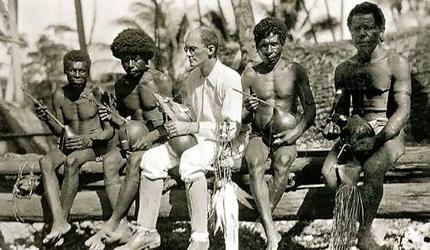
I've had a couple pretty strange ones myself (notably "petticoated bad boy husband", I just knew mentioning petticoats would bring a hit from one of those....um, interesting people with alternative fetishes), but I consistently get hits from people (anthropology students?) looking for information on Argonauts of the Western Pacific or Bronislaw Malinowski. The quote that named this blog came from this 1922 "classic monograph" of cultural and economic anthropology. No, I'm not going to do a book review of Argonauts, and I don't have that much desire to re-read the whole book again, though I did like the introduction and a few parts of the other endless chapters on the kula, canoes, yams, pigs, and conch shells. Obviously I liked the word "imponderabilia" enough to remember it for fifteen years after reading Argonauts, and I love the whole idea of participant observation. After all,

"certain subtle peculiarities, which make an impression as long as they are novel, cease to be noticed as soon as they become familiar. Others again can only be perceived with a better knowledge of the local conditions. An ethnographic diary, carried on systematically throughout the course of one's work in a district would be the ideal instrument for this sort of study. (p. 21, Argonauts).

Obviously my blog isn't particularly systematic, but then again I'm not getting funded by Wenner-Gren or the NSF. This blog is more like Malinowski's personal diary, which was written between 1914 and 1918, packed away in boxes after his death in 1942, and finally published in 1968: A Diary in the Strict Sense of the Term. Since I actually wrote a short book review on this for Sybermoms.com after reading it last year, I thought I'd cut & paste a bit and put it here in my blog so that all those poor Malinowski google searchers get something for their efforts.


First, however, note that Amazon's "statistically improbable phrases" describe Malinowski's diary pretty well: lecherous thoughts, retrospective diary, walked around the village, felt rotten, gorged myself, resident magistrate, wrote diary. Lecherous thoughts! Just what every new anthropology student wants to know about how one of the "old white men" of anthropology really felt. Wow, it occurs 13 times in Malinowski's Diary. How interesting.

Anyway, here's my short review: It reads like a blog, and is surprisingly modern in most parts. Either Malinowski was a hypochrondriac, or he really suffered in the tropics....maybe both. He talks about injecting himself with arsenic fairly often.

He had lewd thoughts about many of the women (both native & colonial) he met during his fieldwork, but except for some "pawing" his lust remained unconsummated. He had some very snarky things to say about various people he encountered (one guy gave him "mental congestion"), and he went on endlessly about his true love, E.R.M., and his pure feelings for her, and how he really needed to make a clean break with N.

There are lots of descriptions of tropical sunsets, and of the famous anthropologist occasionally taking a shit in the mangroves and rowing his dinghy around the lagoon. Besides going on and on about his health, his depression about how much he was accomplishing, and his use of trashy novels to escape all of this, he also complains about his informants and how sick to death of all them he is....which is a pretty interesting contrast with the professional work (especially Argonauts of the Western Pacific).

One of the things Malinowski is best known for is being the first anthropologist to actually live in native villages, learn the language, and engage in everyday activities - now known as participant observation. It is rather fascinating to see how he actually felt about it at the time, and the old-style prose adds to your reading enjoyment. I think they should update the diary with lots of pictures of all the relevant people. Malinowski didn't go on to marry E.R.M. after all! I wonder if she dumped him or he found someone else.

Thursday, June 02, 2005

A Primate's Memoir - Read It Now

Example

If you are at all interested in Africa, brain chemistry, travel writing, primates & social relationships (especially baboons), or anthropology, you should read A Primate's Memoir right now. It's an autobiographical story of a primatologist/neuroscientist studying baboons in Kenya, but it is also a coming of age story, a travelogue, and an introduction to primate behavior. Most of all, it's funny and well-written. Amazingly well-written for an academic. In fact, imagine David Sedaris darting baboons with tranquilizer darts, hitching rides on trucks through the Sudan, doing magic tricks for the Kipsigi with dry ice, and you get an idea of the writing.

Here's an interesting interview with the author, Robert Sapolsky, and more about his book. I'm going to add the rest of his stuff to my huge stack of "to read" books right away. I may even buy a hardcover copy to keep after I return my library copy of A Primate's Memoir.