Showing posts with label words. Show all posts

Saturday, October 25, 2008

From Abluvion to Zyxt (A Book Review of "Reading the OED")

Whenever we come upon one of those intensely right words in a book or a newspaper the resulting effect is physical as well as spiritual, and electrically prompt: it tingles exquisitely around through the walls of the mouth and tastes as tart and crisp and good as the autumn-butter that creams the sumac-berry. One has no time to examine the word and vote upon its rank and standing, the automatic recognition of its supremacy is so immediate.

—Mark Twain, in William Dean Howells, 1906


I love unusual words, especially words that are saturated with history, or words that describe something that I never realized had a word devoted to it (imponderabila, from Bronislaw Malinowski's Argonauts of the Western Pacific fits both criteria for me).

I regularly read Michael Quinion's World Wide Words and WordSpy (adorkable! fauxmosexual!), check wordy books out of the library, and spend far too long rambling through the Internets searching for the origins of phrases like "garden sass" or "fall vs. autumn"- as you can tell if you click on the words label in my righthand sidebar. And I was thrilled when both the Saline District library and the AADL offered access to the Oxford English Dictionary online.


So when I saw Reading the OED: One Man, One Year, 21,730 Pages, by Ammon Shea, I knew it was a book that I should check out. And I wasn't disappointed.

The book is ordered alphabetically (duh), but it's not all words. Well, actually, it is all words, there are no pictures in it, but it isn't all definitions. The essays on dictionaries and reading them are wonderful in their own right:

But what about all the things that you cannot do with the electronic version?

You cannot drop the computer on the floor in a fit of pique, or slam it shut. You cannot leave a bookmark with a note on it in a computer and then come upon it after several years and feel happy you've found something you thought you had lost. You cannot get any sort of tactile pleasure from rubbing the pages of a computer. (Maybe some people do get a tactile pleasure from rubbing their computers, but they are not people I have any interest in knowing anything about.)

....I've never looked across the room at my computer and fondly remembered things that I once read in it. I can while away hours at a time just standing in front of my books and relive my favorite passages merely gazing at their spines. I have never walked into a room full of computers, far from home, and immediately felt a warm familiarity come over me, the way I have with every library I've ever set foot in (p. 56-57).


But on to Shea's favorite words! Here's the first entry in the A's:

Abluvion (n.) Substances or things that are washed away.

Chances are you have never stared at the dirty bathwater washing down the drain and wondered, Is there a word for that? but now you will forever be cursed with the knowledge that indeed there is (p. 5).


My favorite in the A's, though is:

Anonymuncule (n.) An anonymous, small-time writer.

This delightful word is the result of combining anonymous with the Latin word homunculus ("little man"), p. 9.


And constult! Why don't people use this word today? It's perfect:

Constult (v.) To act stupidly together

Taking part in an activity that is inordinately stupid just because one's friends are doing it is not the exclusive province of teenagers - it just seems that way.


Shea has a wry voice, and seeing his opinions come through in the commentary on the definitions and his musings about libraries (public and personal) and the people who use them is just fun. This is one of those books I want to keep on that special shelf devoted to books about books.

My only criticism is that it is too short. Shea mentions that he kept track of many more words than he used in his book. While Reading the OED feels like it is a good length (never a chance to get bored!), I wanted more. More weird words to go look up online, more of his gentle snark, more stories about lexographers past and present.

Besides, where else would I ever have learned that the word fizzle originally meant to fart silently? Unless I read the OED myself, anyway.

Oh, and zyxt is an archaic Kentish word meaning "to see", in case you were wondering about that.

Sunday, October 14, 2007

Julie, Wolves, Vocabulary

I have another writing deadline coming up, so my blogging is limited. I did manage to read Julie of the Wolves, the 1973 Newbery winner by Jean Craighead George, and write a review over at The Newbery Project. When you don't have much time to read for fun, YA or older children's literature is great.

My latest favorite internet time suck is the vocabulary game at the Free Rice charity site. It makes those Reader's Digest "Word Power" tests look like the pap they really are.

But I don't think anguine is a level 40 word. I mean, cruciform is in level 45 and it's much easier to figure out (and much more common). I got to 50 last night, but this morning I stalled at 43 on lustrate and ambagious.

Monday, November 20, 2006

Words, Landscape, and Motherhood

I ran across this blurb for a book I'd really like to get for Christmas (hint, hint) on the Family Scholars Blog:

A group of writers has collected more than 800 fading landscape terms in a new book — Home Ground: Language for an American Landscape. …Nature writer Barry Lopez launched the project after he found that he was unable to double-check the usage of some landscape words, simply because there was no place to look. Poet Michael Collier, who also contributed to the book, believes that the words are worth preserving because “language is the DNA of the culture."

Honestly, this looks like a wonderful book - it's got all my favorite things: eloquent writing, historical depth, beautiful photographs, and descriptions of different environments with personal meaning (that 'sense of place' writers like to talk about). I'm grateful to the Family Scholars for bringing it to my attention, especially since I missed the NPR story last week in the confusion of school conferences, birthday preparations (my son turned ten on Saturday), trips to the veterinarian, and runs to the drugstore for more cold remedies and kleenex.

The remaining part of the Family Scolars post, however, made me stop and think twice:

Reminds me of why some of us are concerned that redefining marriage and parenthood in ways that make us unable to talk about mothers and fathers (but rather simply “parents”) could contribute to more children growing up without their own mom and dad. When you are no longer able to talk about the thing itself you stand a grave risk of losing it — if you have not lost it already.

It is undeniably true that our society is redefining marriage and parenthood. I think that American mothers' and fathers' roles are more flexible than ever before. As more mothers work in formerly male-dominated fields (note that I'm not just saying that more mothers working outside the home - as many historians have shown, mothers working in the fields, in the marketplace, and even in industry are nothing new), and more fathers become more involved in childcare and housework, yes, parenting is evolving.

But what is the relationship between describing what we do for our kids as "parenting" instead of a specific kind of mother's work or father's work and children growing up without a mom or dad? How exactly do flexible gender roles (dad changing diapers, mom mowing the lawn?) contribute to more fragile marriages? Is commitment limited to those with traditional "family values"? Because good parenting is a family value, no matter what you call it or who does specific tasks.

I guess that by calling what mothers do traditionally ("kissing boo boos" as Linda Hirshman sums it up) parenting, as opposed to mothering, mothers do lose some special status. But using a gender neutral term and letting fathers nurture, too, cannot lessen the essential relationship between a child and their mother. As far as I can see, it just gives mom a chance to read the paper while dad reads the kids a bedtime story.

Please note that I don't think that men and women are exactly the same, either biologically, or in how they parent. But men as well as women can certainly nuture, and women can also protect and provide for their children without invoking the end of the world (either culturally or environmentally). Motherhood and fatherhood won't disappear if some of us parent instead of mother, or if Dad cooks and cleans like every day is "Mother's Day". And speaking of bygone phrases: we're not going back to the days when men "wore the pants in the family", and a government where women were active participants was dismissed as "petticoat government".

Friday, October 13, 2006

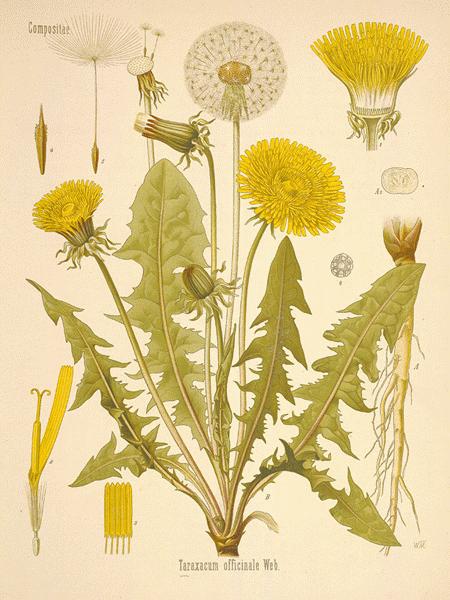
Pissenlit and Dandelions


I was reading the names of crayon colors to my almost-five-year-old daughter the other night. Since starting the "early 5's" Kindergarten program (her birthday is two days before our state's K deadline), she has embraced coloring in a way my son never did. She even likes staying within the lines. But this time, she also wanted to know all of the names of the colors in Spanish and French, which Crayola thoughtfully puts on their crayons.

I was a little surprised to find that Dandelion was a crayon color apart from Yellow. It's a very pretty color, more golden and not as brash as yellow (and quite unlike the brilliant color of actual dandelions). The French name for Dandelion really surprised me, though: Pissenlit. How do you pronounce that? And how weird is it that the French word for dandelion sounds like "piss"?

Well, it's not so weird after all, since piss in French actually means pretty much the same as it does in English, and the whole word translates as "piss in bed". Turns out that an old English name for the dandelion was also "piss-a-bed." Both piss names come from its use as an herbal diuretic. Other more poetic old common names include blowball, peasant's clock, tell-time, lion's tooth, and swine's snout.

There's a lot of interesting folklore about dandelions (linked to many of the common names above). I haven't been able to convince my kids to eat the young leaves in a salad yet, but maybe next spring.

Meanwhile, if you ever want to know the word origins of pissant, piss elm (Chinese elm), and why it was ok for them to say "pisspot" but not "take a piss" on the Waltons, I recommend a search through the archives of the American Dialect Society's mailing list here. It's kind of cool that it is administered by the Linguist List of EMU and Wayne State. I had no idea such a thing existed.

Thursday, September 21, 2006

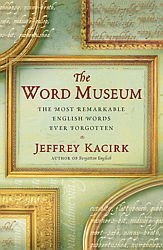
Clapperclaws, Cover-Sluts, and Shachled-Shoes (or The Word Museum: Book Review)

I ran across The Word Museum: The Most Remarkable English Words Ever Forgotten, by Jeffrey Kacirk, in the free swap rack at my local library. I knew almost immediately that I would enjoy browsing this collection of words that the author says were partly chosen for their "Jabberwocky factor" -- basically, how they sound and the images they bring to mind.

As I read, though, it was the social and historical glimpses that many of the words provided that really struck me, and I did start wishing for a little more depth (like Michael Quinion provides in Ballyhoo, Buckaroo, and Spuds). Quinion's site (oooh, and I see he has a new book - Gallimaufry - coming out soon!) really provide that in spades, which I appreciate. Kacirk's book is less research and more "check this fun stuff out", which is sometimes just what you want in a book, especially if you're reading it in the bathroom while your 4 year old splashes in the tub.

Anyway, in his introduction, Kacirk mentions that "teachers and historians, because of their socially prescribed curricular attention toward larger social concepts, often bypassed the smaller and more personal expressions of social custom and conduct" (p. 8). While I don't think that is a fair description of many good teachers or historians (or archaeologists, for that matter), it is undeniably true that the watered-down version of history that many grade school or high school students get fed in the US is de-personalized, over-generalized, and, well, boring. This book is not boring.

Since I've been reading a lot of women's history and feminist theory lately (not as boring as it sounds, dammit!), I took special notice of the words - especially the perjorative ones - in Kacirk's book that were historically applied to women. I thought it was interesting how most of these archaic terms described sexual behavior, uppity-ness, or laziness, which all come together in some feminine stereotypes. These words tell us a little bit about control (and the lack of control) that men had over women in England and Scotland in centuries past:

batterfanged - basically, to be beaten and scratched, and Kacirk adds as by "a termagant". Now there's an interesting word, too, right up there with virago. Check out the bizarre origin of termagant.

clapperclaw - to tongue-beat; to scold. To scratch, maul, fight in an unskillful manner; generally used of women. Hence, a clapperclaw is a noisy woman.

cover-slut - a long apron used to hide an untidy dress (or something in general that hides sluttishness).

curtain-lecture - A reproof given by a wife to her husband in bed. Yes, high-class beds used to have curtains around them.

fishfag - "any scolding, vixenish, foul-mouthed woman". Check out this blogger's description of Ann Coulter that uses fishfag along with many of this book's other entertaining words. It's an interesting twist on the more well-known "fishwife".

giggle-trot - a woman who marries late in life is said to "take the giggle-trot".

idle-worms - worms that breed in the fingers of lazy girls.

laced-mutton - a prostitute (as used in The Two Gentlemen of Verona). Also rigmutton. Some graduate student somewhere has probably written a paper on the symbolism of these comparisons with sheep.

married all over - used to describe women who "fall off in their appearance and become poor and miserable-looking" after marriage. The historic equivalent of "letting yourself go". Check out this Good Housekeeping quiz on how to discover if you're on "the fast track to Frumpville". There's a similar quiz on Oprah's site. Give me a break. Some things really haven't changed in centuries. Which leads us right to the last definition:

shachled-shoes - a no longer useful person, especially "a woman discarded by her lover". Shachled is an old Scottish term meaning distorted and no longer holding its shape. Ouch. So much for "the good old days".

Wednesday, September 28, 2005

Autumn, Fall of the Leaf, and Harvest


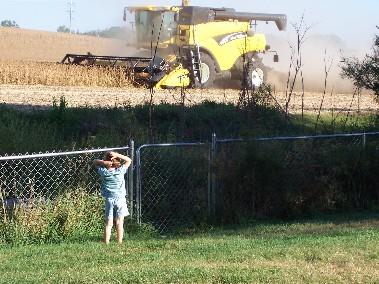
Last week the farmers behind us harvested their soybeans with a very futuristic looking combine. It looked a lot like a Dyson vacuum - but not the one I covet, which is purple and supposed to be especially good at sucking up dog hair.

My son wanted to know why there were two different words for this season. Why both fall and autumn? Which one is it really? Do they mean the same thing? I told him we'd have to google the answer when we got home.

It turns out that this time of year is mainly fall in North America and autumn in Great Britain. This makes sense to me - I bet if I ask most of my neighbors what the names of the four seasons are, they will answer "spring, summer, winter, and fall". They'll probably even list them in that order, though I don't know why it should be so. Possibly it makes sense to start the cycle with spring, but why put winter before fall? Maybe it just sounds better to end on a single syllable. "Winter, spring, summer, and fall" also sounds ok, like you're starting at the beginning of the new year. At any rate, autumn doesn't come into it at all.

In Language and Place, Peter Trudgill explains that

the word autumn is normal in most of southern England, but in parts of the Southwest and in Lincolnshire the traditional dialect word is fall. This reflects the introduction into England in late mediaeval times of the originally French word autumn. This eventually replaced the Anglo-Saxon word fall in Standard English in England and in some of the dialects, but not in others. It is obvious that at one time the use of autumn must have been much less widespread than it is today, since fall was the form which was carried by settlers to North America.

Autumn is definitely a more literary word than fall, although "fall of the leaf", as the season was originally known in England, is rather poetic. Roger Ascham was responsible its first recorded use in 1545, in his book on archery entitled Toxophilus. He explained that it is important to take account of the weather and season when shooting an arrow:

For diversitie of tyme causeth diversitie of wether,
as in the whole yeare,
Sprynge tyme, Somer, Faule of the leafe, and Winter

Peter Trudgill's article goes on explain that "in much of the north of England and Scotland another word, backend, is used" instead of either autumn or fall. After my son finished rolling around the floor after hearing "backend" ("It's the butt of the year!"), we also learned that neither autumn nor fall were used much before 1500 AD. In medieval times, they just called it harvest.

Thursday, September 22, 2005

Cutting the Mustard or the Cheese?

My husband informs me that I'm confusing "cut the cheese" with "cut the mustard", and that only the first phrase refers to farting. I must defer to his expertise in flatulence. I guess that I was thinking about mustard gas when I confused the two.

I e-mailed Michael Quinion and sent him the link my blog review of his book, and he very kindly e-mailed me back and thanked me for the information on Blue's Clues and how Blue and Steve skidoo through pictures to all sorts of educational places. He also corrected my spelling of etymythology, which I immediately went and fixed.

I am having loads of fun browsing his World Wide Words, and am planning on using all kinds of obscure but colorful phrases in my writing. Like makebate: A person who creates contention or strife. But enough bafflegab, the three year old's naptime is over and it's time to pick up my son at school.

Wednesday, September 21, 2005

Ballyhoo, Buckaroo, and Spuds

Sometimes I pick out books based almost entirely on the title (like Christopher Moore's many wonderful books, including The Lust Lizard of Melancholy Cove). Especially if they're free from the library. This was one of those books, and it didn't disappoint.

The complete title is actually Ballyhoo, Buckaroo, and Spuds: Ingenious Tales of Words and Their Origins, by Michael Quinion. In case you are in any doubt of his qualifications, the cover sports the word SMITHSONIAN in big red letters above the title, and "Contributor, Oxford English Dictionary" below his name.

It was a relaxing yet erudite read, perfect for browsing or people with small children and correspondingly short attention spans. Apparently, the internet has spawned quite a few messages on word origins that are best explained as folk etymology or etymological myth, also known as etymythology: "a group of illustrations of the imaginative ways in which people can work very hard to make sense of the unknown" (p.2-3).

Quinion has taken some fun words and phrases, starting with Akimbo and ending with Zzxjoanw, and written short but occasionally ever-so-politely imperious essays on the fictious stories, the obscure and fascinating histories, and the scholarly research that the wonks (yes, that's one of the words reviewed) at the American Dialect Society, the OED and other organizations have undertaken.

Several interesting websites are included in a "Webliography", including Quinion's own World Wide Words, which is definitely the bee's knees. My only disappointments, which I may have to write to him about: there is no mention of farting in "cut the mustard", nor any description of Blue's Clues under "Twenty-Three Skidoo". Possibly Mr. Quinion isn't around anklebiters enough to have absorbed these modern usages.

Wednesday, August 10, 2005

Garden Sass (aka Garden Sauce)

Yspi~dixit has some of the most interesting tidbits and intelligent commentary on her blog, and her question about "garden sauce" sent me googling and dog-piling and blingo-ing across the net, reading all kinds of fascinating excerpts - everything from an 1824 letter from Ann Arbor settler Ezra Maynard to a Betty Crocker cookbook published in 1956. I would have written about this sooner, but I had to take the kids to the playground, Target, a birthday party at Chuck E. Cheese, and feed them, take the van to the dealer for a recall, and do all that everyday stuff that I don't feel like blogging about right now.

First, the quote from the letter that set me off, which is also the earliest web reference I found to "garden sauce" (note all bold emphasis in the following quotes is mine):

Owing to the great emigration into this place, provisions are high and we shall have to pinch a little perhaps till we can raise them ourselves, shall immediately plant some potatoes, garden sauce, and sow some turnips; and calculate to put in some wheat, and plow as much as possible for spring crops...from letter by Ezra Maynard, June 4, 1824.


In 1852, Brigham Young preached the following:

Here are their gardens groaning with abundance of the products of the earth — with potatoes, beets, and cabbage. Here are milk and butter and fine flour in great quantities. Here are the tomatoes and garden vegetables of every description. Now, you say, I have got home, to my brethren’s door, and they have got plenty. What would you wish these brethren to do to you? Ask that same question to your neighbours, and get them to answer it. I can tell you what you would they should do to you. You would wish them to say, Come, brother or sister, into my garden, and help yourselves to some garden sauce; walk in here, and take and eat, and make yourselves glad.


From a letter from a Civil War soldier in the South in 1863:

Very few Southerners ever eat any beans. We have also plenty of garden sauce, cucumbers, beets, etc. and in the streets can get huckleberries, blackberries, apples, pears, peaches, etc.


I found the intriguing title "The Balloon and the Garden-Sauce" on a poem published in 1889 by Irving Browne, but although The Green Bag (an Entertaining Journal of Law!?) is still being published, I haven't searched out the 19th c. issues in any library archives. From these quotes, though, it appears obvious that garden sauce was a term for what we would today call produce: vegetables, grown in a garden, in contrast to grain, grown in fields.

I did not find an explanation of the origins of the term "garden sauce", but did uncover the the following citation from Betty Crocker’s Picture Cook Book, ca. 1956:

In the early days of our own country, vegetables were "garden sauce" or just "sass" to go with meat. Beets and carrots sometimes were referred to as "long sauce", while onions and potatoes were "short sauce". A vendor who sold vegetables from door to door was a "sauce man".


Ah ha! Garden sauce at some point in the early 1900's became "garden sass". A column on “Sauces to Impart Richness”, by Catherine Mackenzie in the June 30, 1935 edition of the New York Times (p.SM12) also describes how:

"...the return of the gardening season serves to recall that vegetables were long known colloquially as "garden sass," and a vegetable garden as a "sauce garden". The Oxford dictionary defines one use of the word “sauce”: “Chiefly US, vegetables or fruit, fresh or preserved, taken as part of a meal or as a relish”.


When you search the web for "garden sass", more interesting citations turn up, including at least three books with the title "Garden Sass" published since 1950; one subtitled “A Catalog of Arkansas Folkways”, another “A Collection of Recipes by the Growing Season”, and the final one “The Story of Vegetables”. It is also clear that sauce is something that accompanies meat, and that at least in the early 20th century, garden sass was not as valuable as meat, or of much account in general. This become more obvious in the following quotes:

He was a little and dried-up man of something like 80 years. Mounted like a manikin on the back of a big white horse, he bore before him a bunch of green corn-fodder, and turned in at the gate to a piece of low ground thick with walnut-trees, between the rows of which the soil was studded closely with that peculiar greenery which delights the peasant soul, and which, when finally realized upon, does not amount to any value whatever; pumpkins and peppers and onions, some spindling stalks of corn for roasting-ears, and all that miscellany which comes under the comprehensive head of "garden-sass," and which, so far as all modern experience goes, it is cheaper to buy than to raise...from Old Californian Days, by James Steele, 1889:164-165


Thirty dollars for tools and seeds, ninety-seven dollars' worth of labor, and four times that amount of worry and vexation of spirit, results in some forty dollars' worth of "garden sass," which is promptly referred to the interior department of the neighbors' cows...from "The Cow", in The Iconoclast, by William Cowper Brann, 1898


At this moment Case pere and mere emerged from the kitchen loaded with provender. "Here`s enough an` more`n enough, I reckon," said Jeb Case. "We got eggs, butter, bread, bacon, milk, an` a mite o` garden sass."

"But we ain`t goin` to charge you nothin` fer the garden sass," interjected Mrs. Case...from The Oakdale Affair, by Edgar Rice Burroughs, 1937, ch. 7.


Today "garden sass" is a quaint phrase, a mention of the Good Old Days found only in historic documents. It also appears to be something you might name a blog or an art exhibit, as in Love Apples and Other Garden Sass, a interdisciplinary show in Brooklyn, where "All the artists in the show individually contribute their ongoing correction of personnel mythologies and unraveling stories, like a garden sass casserole."