The media, from Dr. Phil to the New York Times Magazine, is adamant that there is no love lost between working parents and those who stay home with their children. But what if that's just spin? In reality, as Miriam Peskowitz powerfully discloses, parents don't want to fight one another at all; they simply want more options and less judgment. Moreover, the very sides in this debate don't exist: one third of all mothers work part-time, falling in the vast abyss between full-time career mother and at-home mom.
Tuesday, March 07, 2006
And once more for good measure....
....mommy wars. Read the link:


Googling "Mommy Wars"
Well, I have four different blog posts started, but haven't had time to finish any of them. Instead, I've been working at the grade school book fair, making wheat-free muffins for preschool, and vacuuming my curtains. Even feminazis sometimes like to do a bit of spring cleaning. Especially when their preschooler's playgroup is scheduled at their house in a couple days.
I did want to point everyone towards Rebeldad's post on "The Mommy Wars Solution". Because what I got when I googled "mommy wars"? Almost as disappointing as "Good Morning America's" take on it. Though I did enjoy reading some of the posts in the Mormon Mommy Wars blog (at least until I read the descriptive five year old puking in the bathtub story).
So - if you want to learn something about the mommy wars, read The Truth Behind the Mommy Wars, by Miriam Peskowitz. She has a nice reading group guide and some excerpts here. She uses research and logic! Really. Amazing.
How many blog posts does it take to googlebomb something, anyway? I'll do another for good measure.
I did want to point everyone towards Rebeldad's post on "The Mommy Wars Solution". Because what I got when I googled "mommy wars"? Almost as disappointing as "Good Morning America's" take on it. Though I did enjoy reading some of the posts in the Mormon Mommy Wars blog (at least until I read the descriptive five year old puking in the bathtub story).
So - if you want to learn something about the mommy wars, read The Truth Behind the Mommy Wars, by Miriam Peskowitz. She has a nice reading group guide and some excerpts here. She uses research and logic! Really. Amazing.
How many blog posts does it take to googlebomb something, anyway? I'll do another for good measure.
Sunday, February 26, 2006
Drinking the Rain: Book Review
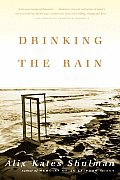 One of the things I love about used book sales is the chance of finding something wonderful for a dollar or two. Books that would otherwise remain hidden on library shelves or buried behind the newer offerings at bookstores can be picked out of a stack of chick lit* as easily as picking a fossil out of a gravel driveway. And that's how I found Drinking the Rain, a memoir by Alix Kates Shulman.
Once again (and only after having read the book), I found that Amazon's "statistically improbable phrases" provided some good insight into content: strawberry goosefoot, dock seeds, sea rocket, lobster buoys. How could I not enjoy a book about a feminist author who spends the summer in a shack on a "nubble" of land on an island off the coast of Maine and teaches herself to forage for food? And why the heck is the word nubble not amongst the statistically improbable? I guess it wasn't paired with any other word regularly enough.
But there is a lot more to like about this short book. The language is clean and powerful and sensuous, and the story is engaging. It expands from an examination of solitude, fear, laziness and the pleasures of getting to know a place intimately, to a wider look at philosophy, New Age beliefs, activism, environmentalism and ecology, family, and female friendships.
Take Shulman's musings about her privy, for example:
Except on the rare still summer day, the single hole, freshened by ocean breezes, collects few foul smells, no flies....Whereas in the city, despite the most lavish bourgeois bathrooms, using the toilet is considered at best indecorous, using this privy is one of the day's most satisfying interludes....From this perfect bird blind of a privy, built on a platform with a protective roof and open front facing the sea, I can watch the swallows feeding their young in the rafters, or follow a marsh hawk glide in low easy loops around the nubble as it hunts field mice. From this pew I have marked the progress of the seasons in the flower-crammed brush: fiddleheads and berry blossoms in early spring, wild roses, nightshade, and touch-me-nots in summer, goldenrod and pale purple asters now, in fall. (p. 72).
You can't get much more down to earth than enjoying (and describing) your outhouse. And people who enjoy reading about food will like Shulman's passionate descriptions of collecting, cooking, and tasting all sorts of new foods - not just the wild greens and shellfish of her island. Her description of the farmer's market in Budapest, with its wild game, piles of multicolored and frilled mushrooms, desserts and terrines and tripe and goose livers - well, it's better than salivating over the food porn in magazines like Bon Appetit.
Shulman's approach to philosophy was similarly refreshing. At one point, she describes how she picked up an abandoned college textbook containing James Baldwin's "Notes of a Native Son" while waiting for her serviceberry pie to bake. This led her to consider her life in terms of "acceptance and resistance, contemplation and struggle....How can one live without rancor in a world steeped in suffering and injustice - or live without contentment in a world bathed in birdsong at sundown?" (p. 60).
I thought this passage was worth pointing out, since this issue comes up repeatedly while discussing motherhood (see for example this blog post from last year's Mothers & More Mother's Day campaign and the comments). "Can't you just enjoy being a mother?...Your children are little for such a short time," many women say. Or as Darla Shine might say, "Just stop whining". "Why dwell on the problems? Enjoy what you have."
Shulman eloquently points out how both philosophies can be encompassed in one world view, and in an individual:
...my acceptance and love of this life making passivity impossible. The more I love it the more I care about its fate, our fate, want to protect the suffering seas, the weeds, the air, the spawn, and each neglected old woman. But equally for me, the second is the cause of the first. For, from my first embrace of our soul-stirring movement at the dawn of my adulthood, fighting injustice was my main path into the world, my connection with each living soul, the way I came to write, to know myself, and to love the world." (p. 240-241).
And then Shulman ends her book, somewhat as she began, "in medias res, somewhere in the middle" - contemplating her outhouse and the world.
I'll be giving this serendipitous find a permanent place on my bookshelves. I'm just not sure whether to shelve it next to James Duke's Handbook of Edible Weeds or Zen and the Art of Motorcycle Maintenance.
*Not that I mind dipping into the pink stuff, but chick lit is pretty common and easy to find, unlike books like this one.
Saturday, February 25, 2006
See "Mamas in Blogland"....
...for some fascinating reading on "maternal narrative, momoirs, and the rise of the blog", "blogging mom cliques" and much more over at The Mothers Movement Online. How come no one at Good Morning America solicited someone from that site for their show on "The Mommy Wars"? Could it be that sound bites and conflict are more entertaining than a real look at the social issues that undermine mothers and families as a whole in our society?
Also, read Are We Having Fun Yet? on MMO for a more in-depth look at parenting and depression (like much of the mainstream media, I did a cursory blurb on a study that is considerably more complicated than it seemed). Since this kind of facile misinterpretation of scientific studies is one of my pet peeves, and I was just complaining about sound bites a minute ago, I thought I had really better post the link.
Also, read Are We Having Fun Yet? on MMO for a more in-depth look at parenting and depression (like much of the mainstream media, I did a cursory blurb on a study that is considerably more complicated than it seemed). Since this kind of facile misinterpretation of scientific studies is one of my pet peeves, and I was just complaining about sound bites a minute ago, I thought I had really better post the link.
Thursday, February 23, 2006
9th Carnival of Feminists...
...coming to you from Wales at Mind The Gap!
Thought-provoking posts on violence, prostitution, motherhood, marriage, politics, religion, with a special focus on the female body and body image.
Monday, February 20, 2006
Ada Blackjack: A Book Review
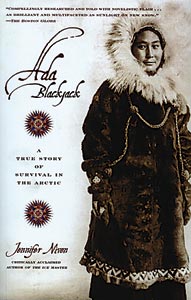 Ada Blackjack: A True Story of Survival in the Arctic, by Jennifer Niven is the second really excellent historical book set in the 1920's that I've read this winter. Like Kevin Boyle (though perhaps without his historian's perspective), Niven has researched the scraps of documentary evidence and written a totally gripping story. It's all too easy to imagine being on that bleak island above the Arctic Circle north of Siberia. Niven's story - or rather her telling of Ada's story - sucks you in and makes what happened even more shocking and appalling.
Basically, an ill-fitted arctic exploration was put together by entertainer/explorer Vilhjalmur Stefansson in the early 1920's. He persuaded four young men (Allan Crawford, Fred Mauer, E. Lorne Knight & Milton Galle) to go claim this desolate island for Canada and write about it for science, for glory, to show that men could conquer the Arctic. Two of them had some experience in the Arctic; Mauer had in fact almost died several years earlier when marooned on Wrangel Island.
A series of accidents happened on the way to Wrangel Island - the umiak (skin boat that was a must for seal & walrus hunting) blew off the ship taking them there, the Eskimo families they hired all backed out at the last minute (except for the main character, Ada, who was too desperate to earn money sewing winter clothes for the explorers so she could help her sick toddler), and the relief boat that was supposed to come the following summer couldn't make it because of the weather.
It got progressively worse. Finally, seeing that they were running out of food and they wouldn't be able to hunt enough on the island to survive the second winter, three of men took the remaining dogs & sled and set off for help. Ada was left with Knight, who was too ill from scurvy to handle the trip.
Ada ended up teaching herself to hunt and trap to keep herself and Lorne Knight alive. Unfortunately, Knight's scurvy progressed, and he died in the middle of the second summer there. Ada spent a couple of months by herself, terrified of the polar bears, reading Knight's bible, and thinking of her son in Nome. Harrowing doesn't begin to describe it.
I didn't really expect a happy ending, since the three men that went for help were never heard from again, but the aftermath - the reporters hounding Ada, the finger pointing and blame, the racism, the attempts of the four families to come to terms with the loss of their sons, and Ada's continued hardships - were all fascinating, as were the different backgrounds and personalities of the five people on the island from 1921-1923.
The pictures and the diaries that the men and Ada kept were haunting. There were so many "ifs" - "if only they'd had an umiak", "if only Knight had recognized the symptoms of scurvy earlier", "if only they'd stored more meat earlier in the year", "if only the weather hadn't been so bad"....
Anyway, this book is highly recommended if you like history, the Arctic, or stories of endurance. For some more background on Ada & the expedition, check out this Alaska LitSite on The Heroine of Wrangel Island.
Friday, February 17, 2006
Way to Go, Ypsi: Bus Service Cuts Proposed
Ever use the AATA? Know anyone who does? If you give a damn about public transportation between Ann Arbor and Ypsilanti (and you should if you live in this area), go to ypsi~dixit and sign a petition. There's also a good post explaining the importance of these bus routes on MapRoom Systems.
Wednesday, February 15, 2006
Now Which Day of the Year Would This Be?
Because I really, really love this idea (shamelessly stolen from BookLust):
I think that late February or March would be perfect for this. The weather usually sucks in the midwest then, which makes me more likely to read than to do many other things, like go out in the yard and pick up thawing dog poop.
Actually, there should be a new holiday, where we celebrate books and reading, and we buy each other and ourselves nothing but books and book paraphernalia! Instead of hearts and flowers filling our heads, the whole day should be focused on everything biblio. We could call it Bibliotine's Day! Send yourself or your loved one a bibliotine!
I think that late February or March would be perfect for this. The weather usually sucks in the midwest then, which makes me more likely to read than to do many other things, like go out in the yard and pick up thawing dog poop.
Monday, February 13, 2006
Goodbye A Common Reader, I'll Miss You
 Sometime in January, I decided I needed something rural and relaxing to read...so I clicked on the link for the online catalog of
A Common Reader, with their wonderfully descriptive offerings in strange but satisfying categories like "Domestic Pleasures" and "Rural Retreats". I was annoyed when all I got was a blank page saying "Season's Greetings" but figured it was a temporary problem.
When I realized the link still wasn't working almost a month later, I did some googling and found this sad Wikipedia entry:
A Common Reader is an American mail-order book catalogue established in 1986 by James Mustich, Jr. It is notable among general-interest book catalogues for its eclecticism, with large sections of each issue given over to obscure literary classics. The catalogue also has a reputation among its readers for the quality of its writing. The blurbs that accompany each book entry are often highly erudite and evocative, and many of these are penned by Mustich himself.
A Common Reader appears several times a year.
As of January 27, 2006, the organization appears to be out of business - there is no answer at their 800 number, and their web site yields only an empty page.
They have gone into bankruptcy - there is to be an auction of their stock and equipment on February 22, 2006 in Pleasantville, NY.
I wish I'd saved all the back issues of their catalog. It was better reading than a lot of books. It never occurred to me that they might suddenly disappear. Due to my fairly limited budget for buying new books, I used the catalogs primarily as a starting point for searching used bookstores or requests from inter-library loan. I'm afraid I'm part of the reason that the company isn't here anymore.
Just a few of the authors they introduced me to include: Gervaise Phinn, Rose Macauly, Patrick O'Brian, Charles Elliot, Stephen Leacock, Elisabeth Luard, Mark Kurlansky, Louise Dickinson Rich, Betty MacDonald, and Lillian Beckwith. Many of these authors were popular a generation or two ago or are well known in the UK but not in the US. They're still well worth reading, but I wouldn't have ever picked them up if I hadn't read those evocative blurbs in A Common Reader, and my life would be immeasurably smaller. So thanks for what you did, A Common Reader folks, wherever you are. I'll miss you.
Sunday, February 12, 2006
Birthdays
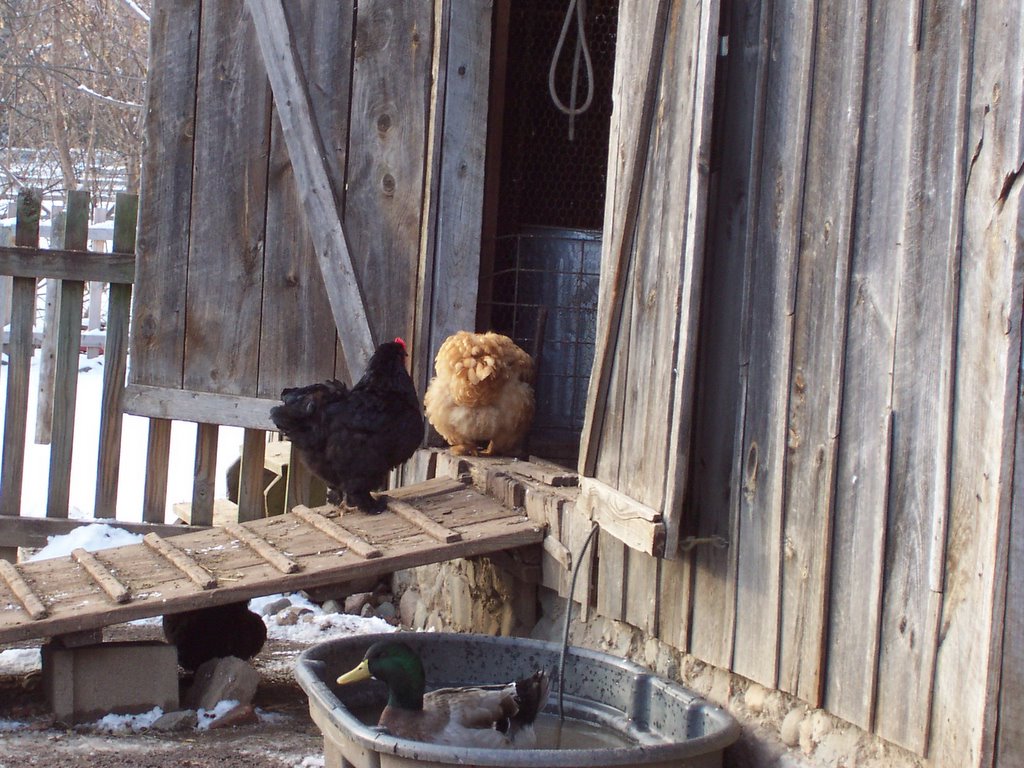
Happy 197th birthday to Abraham Lincoln and Charles Darwin. With 43 years behind me (as of this morning), I'm still a spring chicken. Whatever that means.
Saturday, February 11, 2006
The More Things Change....

...the more they stay the same.
I myself have never been able to find out precisely what feminism is: I only know that people call me a feminist whenever I express sentiments that differentiate me from a door mat or a prostitute.
- Rebecca West, in 'Mr. Chesterton in Hysterics: A Study in Prejudice', first published in The Clarion, November 14, 1913
1913? Did you see that date? Is this not still true almost a hundred years later?
If you had any doubts about about it after my post on Hypocrites and Feminazis, check out a couple of hysterically funny posts called Chucking Oprah and Only Women Are Allowed to Read this Post about an article published in O: The Oprah Magazine* just last summer. Hmmm, hysterically funny is rather good here, given the origins of the word hysterical.
How can anyone say feminists lack a wicked good sense of humor? Given all of the recent CRAP (Committee for Retrograde Antifeminist Propaganda)** I've read, I'm going to go re-read 'The New Momism' and 'Revolt against the MRS' in The Mommy Myth, by Susan Douglas and Meredith Michaels. When I read it in 2004 I thought it was perhaps a little overstated and over the top; now it looks downright prescient.
*perhaps this is why it is listed as one of "Darla's Favorite Resources" in Happy Housewives, by Darla Shine
**see pages 30-33 of The Mommy Myth: The Idealization of Motherhood and How It Has Undermined Women
Wednesday, February 08, 2006
8th Carnival of Feminists
Now playing at Gendergeek. Read all about academia & sexism, vacuums & housework expectations and the domestic glass ceiling, chick lit book covers, Commander in Chief, obesity, spike heels, Linux, fanfiction, sex positiveness and porn, and some farewells to famous women. And much more that I haven't had a chance to read yet.
Tuesday, February 07, 2006
Parenting is Stressful
And if you don't believe it, check out this Science Blog story:
Their conclusions?
It would be interesting to see if this pattern of depression holds true cross-culturally.
A study by Florida State University professor Robin Simon and Vanderbilt University's Ranae Evenson found that parents have significantly higher levels of depression than adults who do not have children. Even more surprising, the symptoms of depression do not go away when the kids grow up and move out of the house.
Their conclusions?
"It's how we do parenting in this society," Simon said. "We do it in a very isolated way and the onus is on us as individuals to get it right. Our successes are our own, but so are our failures. It's emotionally draining."
The value of a study like this is that it presents a realistic view of the difficulties associated with parenthood and encourages parents to seek greater social support, Simon said.
"Parents should know they are not alone; other people are feeling this way, too," she said. "This is a really difficult role, but we romanticize it in American culture. Parenthood is not the way it is in TV commercials."
It would be interesting to see if this pattern of depression holds true cross-culturally.
Monday, February 06, 2006
Hypocrites and Feminazis
"“So if you want to be a happy housewife, stop gossiping about your girls, open yourself up to new friendships, be nice, make new girlfriends, keep them in your life, and please don'’t be a bitch....I wish we could all stop the whining, the complaining, the cliques, the bitterness. I wish we could be great girlfriends. I wish we could all realize how lucky each one of us is and that we all have much to bring to the table. We'’re all the same. We'’re moms. We want the best for our children. We all want a safe, clean world for them to grow up in."” (Darla Shine, p. 32, Happy Housewives).
Compare this to the new homepage on www.darlashine.com:
Become a Member!
You need to be a SAHM
If you are one, you know what that means
Click Darla's apron to login or register
Is this exclusionary? YOU BETCHA!
This site is for Happy Housewives
All Feminazi's Stay Out!
Betty Friedan would have had something pithy and succinct to say about this. Maybe something about those that don't know their history are doomed to repeat it? And are all feminists automatically feminazis, or do I have to do something special and um....exclusionary to become one?
In case you want to read some of my earlier posts on gender roles and feminism: Matters of Style and Presentation, On "The Stay-At-Home Mystique", Happy Housewives and the Cult of Domesticity in the 21st Century, Petticoat Philosophy and Government and Mothers and Fathers in America are the most relevant ones. Take a peek at the comments, some of them are quite enlightening.
Wednesday, February 01, 2006
Google Searches, Malinowski, and Argonauts
I've read a couple interesting posts lately on what bizarre strings of words people searched to get to your blog. There are some funny mom-oriented ones at Real Talk about Motherhood (matronly breasts? crisco then and now?), and some really strange ones at Bootstrap Analysis ("Walt Whitman and the Pointer Sisters"? "What are the sharpest parts of a cat"? "farting treetop sounds"???).
I've had a couple pretty strange ones myself (notably "petticoated bad boy husband", I just knew mentioning petticoats would bring a hit from one of those....um, interesting people with alternative fetishes), but I consistently get hits from people (anthropology students?) looking for information on Argonauts of the Western Pacific or Bronislaw Malinowski. The quote that named this blog came from this 1922 "classic monograph" of cultural and economic anthropology. No, I'm not going to do a book review of Argonauts, and I don't have that much desire to re-read the whole book again, though I did like the introduction and a few parts of the other endless chapters on the kula, canoes, yams, pigs, and conch shells. Obviously I liked the word "imponderabilia" enough to remember it for fifteen years after reading Argonauts, and I love the whole idea of participant observation. After all,
Obviously my blog isn't particularly systematic, but then again I'm not getting funded by Wenner-Gren or the NSF. This blog is more like Malinowski's personal diary, which was written between 1914 and 1918, packed away in boxes after his death in 1942, and finally published in 1968: A Diary in the Strict Sense of the Term. Since I actually wrote a short book review on this for Sybermoms.com after reading it last year, I thought I'd cut & paste a bit and put it here in my blog so that all those poor Malinowski google searchers get something for their efforts.
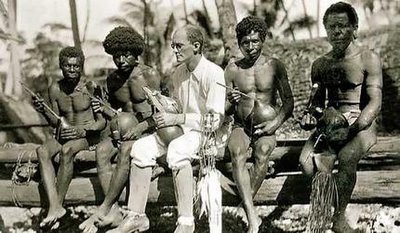
First, however, note that Amazon's "statistically improbable phrases" describe Malinowski's diary pretty well: lecherous thoughts, retrospective diary, walked around the village, felt rotten, gorged myself, resident magistrate, wrote diary. Lecherous thoughts! Just what every new anthropology student wants to know about how one of the "old white men" of anthropology really felt. Wow, it occurs 13 times in Malinowski's Diary. How interesting.
Anyway, here's my short review: It reads like a blog, and is surprisingly modern in most parts. Either Malinowski was a hypochrondriac, or he really suffered in the tropics....maybe both. He talks about injecting himself with arsenic fairly often.
He had lewd thoughts about many of the women (both native & colonial) he met during his fieldwork, but except for some "pawing" his lust remained unconsummated. He had some very snarky things to say about various people he encountered (one guy gave him "mental congestion"), and he went on endlessly about his true love, E.R.M., and his pure feelings for her, and how he really needed to make a clean break with N.
There are lots of descriptions of tropical sunsets, and of the famous anthropologist occasionally taking a shit in the mangroves and rowing his dinghy around the lagoon. Besides going on and on about his health, his depression about how much he was accomplishing, and his use of trashy novels to escape all of this, he also complains about his informants and how sick to death of all them he is....which is a pretty interesting contrast with the professional work (especially Argonauts of the Western Pacific).
One of the things Malinowski is best known for is being the first anthropologist to actually live in native villages, learn the language, and engage in everyday activities - now known as participant observation. It is rather fascinating to see how he actually felt about it at the time, and the old-style prose adds to your reading enjoyment. I think they should update the diary with lots of pictures of all the relevant people. Malinowski didn't go on to marry E.R.M. after all! I wonder if she dumped him or he found someone else.
I've had a couple pretty strange ones myself (notably "petticoated bad boy husband", I just knew mentioning petticoats would bring a hit from one of those....um, interesting people with alternative fetishes), but I consistently get hits from people (anthropology students?) looking for information on Argonauts of the Western Pacific or Bronislaw Malinowski. The quote that named this blog came from this 1922 "classic monograph" of cultural and economic anthropology. No, I'm not going to do a book review of Argonauts, and I don't have that much desire to re-read the whole book again, though I did like the introduction and a few parts of the other endless chapters on the kula, canoes, yams, pigs, and conch shells. Obviously I liked the word "imponderabilia" enough to remember it for fifteen years after reading Argonauts, and I love the whole idea of participant observation. After all,
"certain subtle peculiarities, which make an impression as long as they are novel, cease to be noticed as soon as they become familiar. Others again can only be perceived with a better knowledge of the local conditions. An ethnographic diary, carried on systematically throughout the course of one's work in a district would be the ideal instrument for this sort of study. (p. 21, Argonauts).
Obviously my blog isn't particularly systematic, but then again I'm not getting funded by Wenner-Gren or the NSF. This blog is more like Malinowski's personal diary, which was written between 1914 and 1918, packed away in boxes after his death in 1942, and finally published in 1968: A Diary in the Strict Sense of the Term. Since I actually wrote a short book review on this for Sybermoms.com after reading it last year, I thought I'd cut & paste a bit and put it here in my blog so that all those poor Malinowski google searchers get something for their efforts.
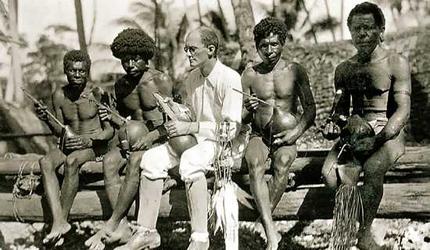
First, however, note that Amazon's "statistically improbable phrases" describe Malinowski's diary pretty well: lecherous thoughts, retrospective diary, walked around the village, felt rotten, gorged myself, resident magistrate, wrote diary. Lecherous thoughts! Just what every new anthropology student wants to know about how one of the "old white men" of anthropology really felt. Wow, it occurs 13 times in Malinowski's Diary. How interesting.
Anyway, here's my short review: It reads like a blog, and is surprisingly modern in most parts. Either Malinowski was a hypochrondriac, or he really suffered in the tropics....maybe both. He talks about injecting himself with arsenic fairly often.
He had lewd thoughts about many of the women (both native & colonial) he met during his fieldwork, but except for some "pawing" his lust remained unconsummated. He had some very snarky things to say about various people he encountered (one guy gave him "mental congestion"), and he went on endlessly about his true love, E.R.M., and his pure feelings for her, and how he really needed to make a clean break with N.
There are lots of descriptions of tropical sunsets, and of the famous anthropologist occasionally taking a shit in the mangroves and rowing his dinghy around the lagoon. Besides going on and on about his health, his depression about how much he was accomplishing, and his use of trashy novels to escape all of this, he also complains about his informants and how sick to death of all them he is....which is a pretty interesting contrast with the professional work (especially Argonauts of the Western Pacific).
One of the things Malinowski is best known for is being the first anthropologist to actually live in native villages, learn the language, and engage in everyday activities - now known as participant observation. It is rather fascinating to see how he actually felt about it at the time, and the old-style prose adds to your reading enjoyment. I think they should update the diary with lots of pictures of all the relevant people. Malinowski didn't go on to marry E.R.M. after all! I wonder if she dumped him or he found someone else.
Friday, January 27, 2006
Arc of Justice

The arc of the moral universe is long,
But it bends toward justice.
-Abolitionist Theodore Parker, c. 1850's
That Justice is a blind goddess
Is a thing to which we blacks are wise.
Her bandage hides two festering sores
That once perhaps were eyes.
-Langston Hughes, 1923
(from the frontspiece of Arc of Justice).
Arc of Justice: A Saga of Race, Civil Rights, and Murder in the Jazz Age, by Kevin Boyle is an incredible book. It is very obviously meticulously well-researched (there are masses of endnotes on newspaper articles, court transcripts, insurance & real estate info., etc) - the author is a professor of history at Ohio State, but grew up in Detroit and got his PhD at the University of Michigan.
Boyle narrates the story of Ossian Sweet, an African-American doctor who bought a house for his wife & 14 month old daughter in a white neighborhood in Detroit in 1925. When a violent mob of hundreds of people surrounded the house the second night after they moved in, one of the 11 people trapped in the house shot a gun out of an upstairs window and one man on the street was killed and another was wounded.
Boyle starts out with a riveting account of the night this happened, then moves back to provide Sweet's family history and a good history of Reconstruction and Jim Crow in the south, and then the Great Migration to the industrial northern cities in the years following WW I.
He makes it easy to imagine living in Detroit in the 1920's, either as an immigrant workman in the Ford plants, or as a doctor or housewife in the black ghetto in Detroit (the "Black Bottom" or Paradise Valley). He shows how ghettos and residential segregation developed from the economic and social changes of the 20's, and how the all-pervasive racism of the day fueled this.
Some of the mechanics of the history are a bit dry, but Boyle manages to bring the economy, sociology, and history back to actual people and how they dealt with these changes and events, and that really keeps you reading.
A lot of the history is shocking and not something that you probably read about in high school (or even college) when you learned about this era: lynchings and race riots. I never knew about the early 20th century riots in Chicago, Springfield, IL, Tulsa, East St. Louis, or Rosewood, FL until a few years ago. This book makes you realize that the north has nothing to be sanctimonious about just because there weren't as many lynchings here.
The last third or so of the book deals with the murder trial (all eleven people in the house were co-defendants, and included two of Ossian's brothers and his wife Gladys). The NAACP made it into a national event, and got Clarence Darrow (who had just finished the Scopes trial earlier in the year) to be one of the defending attornies.
I learned a huge amount about Detroit politics, the KKK, immigration and real estate practices. Boyle finishes up with a look at how segregation developed in Detroit (and elsewhere in the US) after the trial, and what happened to everyone involved after the trial. Not coincidentally, Detroit is still the most segrated major city in the US*.
There is a major shock at the very end, which I'm not going to spoil, so whatever you do don't read the ending of the book before reading the rest.
HNN has an interesting interview with Boyle, where he talks about why he chose Ossian Sweet's story, his research, and some of the other titles he considered. You can take a look at the Sweet house on the National Park Service's Register of Historic Places (where a marker was just put up in 2004), or here at a wonderfully detailed site provided by the Population Studies Center of the Institute for Social Research at University of Michigan. Just don't read the accompanying text unless you want spoilers for the book, or you know that you're not going to read the book.
There are pictures of all the major characters and more information on the trial here, and an interesting article in American History magazine was written in 2000 by John F. Wukovits.
*CensusScope says the Gary, IN metro area is slightly worse, but note how many other Michigan cities are in the top 25.
Thursday, January 26, 2006
Flying Beagles
I don't know why it is so endearing when preschoolers get their words mixed up, but it is. Right now my 4 year old daughter confuses "eagle" with "beagle". This is especially confusing when she's playing with a little plastic vulture from a Happy Meal, exclaiming "Look at my flying beagle!" (whose favorite food is apparently string cheese).
Other recent word switches that took a few minutes to figure out were "caboose" instead of "cafeteria" or "lobby". Why yes, we can go into the caboose at your brother's school.
Other recent word switches that took a few minutes to figure out were "caboose" instead of "cafeteria" or "lobby". Why yes, we can go into the caboose at your brother's school.
Monday, January 23, 2006
Mothers and Fathers in America
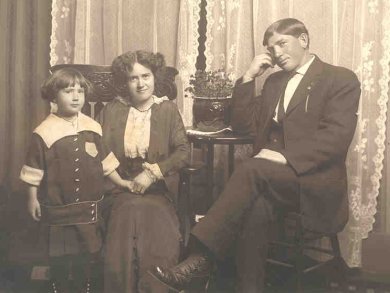
Men's and women's domestic roles are not ordained by human nature, biology, or men's and women's psychology. Rather, they are the product of particular historical circumstances, social processes, and ideologies, and vary widely by race, religion, and time period. Far from being fixed and static categories, motherhood and fatherhood are social, cultural, and ideological constructs. Their social definition and meaning has been changing, varied, and contested (by Steven Mintz, 2003; Mothers and Fathers in America: Looking Backward, Looking Forward, in Digital History).
This is the first paragraph of a fascinating essay on how Americans have perceived mothers and fathers over the last 300 years. I keep pondering how much of what Darla Shine and her supporters say echoes so many historical things I've read, like the wonderful online exhibits by the UVA's American Studies program on Late 19th Century Advice for Women, The Nineteenth Century 'Cult of the Lady', and the McCord Museum of Canadian History's Thematic Tour on The Cult of Domesticity.
Then there are the more recent popular works, like this commonly found internet graphic of the Good Wife's Guide from 1955's Housekeeping Monthly. Jennifer Heller has an interesting paper on Marriage, Womanhood, and the Search for 'Something More' through the 1970's in the Journal of Religion and Popular Culture that includes a look at Marabel Morgan's The Total Woman, which really did have many amazing parallels with Happy Housewives, both in content and in terms of its self-help orientation.
But back to Steven Mintz and his amazing, challenging essay. It's a fairly long article, but really eye-opening, and I urge everyone who makes statements about what is "natural", "best", "the way it should be" or "the way it's always been" for mothers or fathers to read this before saying anything so simplistic again. Mintz's conclusion, which I think most of us would find unarguable: "What is unique today is that the conceptions of fatherhood and motherhood are more problematic and contested politically than at any time in the past."
Saturday, January 21, 2006
Some Books for 9 Year Old Boys
 ...based almost entirely on my son's recent reviews. Some he picked out himself, some I saw on the new book shelf in the kids' section of our library, and he couldn't get enough of them. Which is a very good thing on a winter teacher inservice day when it is raining cats and dogs.
Billy Clikk: Creatch Battler and its sequel Billy Clikk: Rogmasher Rampage by fellow Michigander Mark Crilley were the most recent favorites. Great comic-book like illustrations, fun science fiction, we'll be checking his Akiko series out next. Hey, it's important that I read what he reads to make sure it's ok, right?
 Another series by a Michigan author that is on its way to becoming more popular in the rest of the country is Jonathan Rand's American Chillers and the (even cooler for those of us living in Michigan) Michigan Chillers. They're a bit like the much maligned Goosebumps books, but I absolutely love the titles and the cover illustrations. Alien Androids Assault Arizona, Minnesota Mall Mannequins, Poltergeists of Petoskey, Kreepy Klowns of Kalamazoo, Sinister Spiders of Saginaw - who could ask for more? Except for some more titles on Ann Arbor, Lansing, Tecumseh, Benton Harbor, Cheboygan, Grayling, Kalkaska, Saugatauk....you get the idea.
Jonathan Rand himself is coming to visit my son's school for "Reading Week" in March, so I'm looking forward to getting a copy of Au Sable Alligators then.
And last but not least, How to Train Your Dragon (by Hiccup Horrendous Haddock III), translated from the Old Norse by Cressida Cowell, and its sequel How to Be a Pirate, have the funniest illustrations I've seen since Captain Underpants. My son was begging for more of these, though he had to ask about some British slang.
You've probably noticed that these are pretty boy-oriented books. My son, like many of his classmates, was not an enthusiastic reader in Kindergarten and 1st grade. Luckily, Calvin & Hobbes cartoon books and Captain Underpants got him hooked on independent reading, and now he will even read to his 4 year old sister with minimal urging. He still prefers the the kind of stuff recommended on GuysRead.com, however. He has little interest in Little House on the Prairie, so it's a good thing these authors have all these great books that appeal to boys (and that happily also have active girls that rank right up there with the Paper Bag Princess). My son really gets into series books, which according to the recent Newsweek article "A Series of Extraordinarily Fortunate Events" (get it? maybe you have to know Lemony Snicket) can be a good thing. Maybe it's a good thing my parents still have all those Hardy Boy and Nancy Drew books.
Wednesday, January 18, 2006
7th Carnival of the Feminists...
...now appearing at Feministe. This issue focuses on pop culture and feminism, so if you're interested in blogs, celebrities, comic books, movies, museum exhibits, popular books, tv shows, or video games, be sure to check it out.
Tuesday, January 17, 2006
Petticoat Philosophy and Government
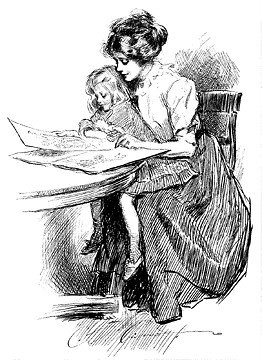 "No Time for Politics", by Charles Dana Gibson, 1910
Of all those acquirements which more particularly belong to the female character there are none which take a higher rank, in our estimation, than such as enter into a knowledge of household duties; for on these are perpetually dependent the happiness, comfort and well-being of a family. In this opinion we are borne out by the author of 'The Vicar of Wakefield' who says: the modest virgin, the prudent wife, and the careful matron, are much more serviceable in life than petticoated philosophers, blustering heroines, or virago queans (sic). She who makes her husband and her children happy, who reclaims the one from vice and trains up the other to virtue, is a much greater character than ladies described in romances, whose whole occupation is to murder mankind with shafts from their quiver, or their eyes...
Good Temper should be cultivated by every mistress, as upon it the welfare of the household maybe said to turn; indeed its influence can hardly be over-estimated, as it has the effect of moulding the characters of those around her, and of acting most beneficially on the happiness of the domestic circle. Every head of a household should strive to be cheerful, and should never fail to show a deep interest in all that appertains to the well-being of those who claim the protection of her roof. From The Book of Household Management: With a History of the Origin, Properties, and Uses of all things connected with Home Life and Comfort, by Mrs. Beeton (1869).
So - no philosophy, no arguing, no whining, no nagging. Be happy with the status quo. Got it? But if you want to read more of Mrs. Beeton's famous Book of Household Management, check out this site on the Ideals of Womanhood in Victorian Britain.
This was the standard advice for marriage in the mid-19th century, and some women (and not just "surendered wives") still think that's the way to go. I didn't go into it in my last post on Happy Housewives, but there's a lot in this just published book about how you should admire your husband, respect your husband, stop nagging, stop whining, get a good attitude and be grateful for what you have.
The phrase "petticoated philosophers" in Mrs. Beeton rang a bell with me - there is a fascinating history (in the US and Great Britain, anyway) of using "petticoats" to describe anything female in a disparaging manner. So for the last few centuries, at least, there were many popular references to "petticoat government" - both in terms of households 'unnaturally' ruled by women, and for different cultures (like the 18th century Cherokee), where women took an active part in politics and had a lot of personal autonomy.
Petticoatery shouldn't be confused with pettifoggery, although they both do share that diminutive prefix. But I don't want to be petty, so I'll stop here. Really, who wears the pants* in your house, anyway?
*or trousers, or breeches
Warning: Don't google petticoats unless you want to learn a lot about the cross-dressing habits of some British men. It's almost as scary as when I was pregnant and looked for cloth diapers for my baby on the internet.
Monday, January 16, 2006
"Happy Housewives" and the Cult of Domesticity in the 21st Century
 I'm the target demographic for Darla Shine's recent self-help book titled Happy Housewives. I'm the right age, I gave up a career and professional training to stay home with two young kids, and I do the majority of the housework in our now seemingly June Cleaveresque household. I don't think or feel like June Cleaver, though. As I read Shine's book, I did wonder if some of my distaste for the book might stem from the fact that I am not as wealthy nor as conservative as the stay-at-home moms she depicts. I think that it could have been more accurately titled Happy Rich Republican Housewives.
There were some good things about this book. It is an honest and heartfelt account of one woman's life and how she took control of the aspects of it that were making her "a whining, miserable, desperate housewife." It is simply written and a quick (sometimes humorous) read, and includes some good recipes and gardening advice. If the comments on amazon.com and a couple of SAH-mom blogs (see MotherSong and The Politically Incorrect Mom) are any indication, it has proven inspirational to many women.
However. There was a lot that really disturbed me in this happy, "I'm just talking to my girls" motivational book. First and foremost, as Jen has elaborated on in her LiteraryMama blog essays on My Happy Inner Housewife and My Inner Housewife: Shine Responds, there is the assertion that staying at home with your kids is always superior to working outside the home. There are no qualifications to this statement. (How about working while your kids are in school? How about part-time work? How about a stay-at-home dad?):
“Many of us are torn between our careers and our families. We work very hard, only to have to give it all up. What choice do you have? This is really what you were meant to do. If you made the choice to get pregnant, you should make the choice to stay home with that baby if you can afford to, and I think most of you could afford to.” (p. 19 in Happy Housewives, henceforth HH, emphasis mine).
I also found the advice on being a housewife (aka SAH-mom) unsettling. Darla states that she is unequivocally against the whole "Desperate Housewives" idea of competitive mothering, but she sends very mixed messages with her advice:
“I think one of the biggest reasons housewives have a bad image is that a lot of moms have let themselves go. Admit it, girls. Most housewives are in desperate need of a makeover – out-of-date hairstyles, jeans that should have been thrown out years ago, and worst of all, what I really cannot handle, no makeup!”, p. 32, HH.
Yes, I'm sitting here wearing jeans with holes, an old flannel shirt, and no make-up. This is what I wore to work as a professional archaeologist, however, and my husband still wants to have sex with me and I haven't been rejected by the other moms on the playground or my local Mothers & More group.
“We look cute, we’re thin, we’re in style, and we’re hot mamas! At least we think so. We’re constantly on top of each other, policing each other to make sure we don’t fall off the wagon. We force each other to look good……If you need help, look at what the women are wearing in the magazines. Real women in magazines like More, Redbook, Ladies’ Home Journal, Woman’s Day, and InStyle.”, p. 33, HH.
Thankfully, I can't imagine any of my friends policing what I wear. And I was under the impression that the women shown in most magazines were media creations, not candid snapshots of real women. Even the women in that Dove Campaign for Real Beauty are not really real, if you know what I mean.
“The whole mommy clique thing is stronger than ever in the suburbs. I have been really studying this phenomenon, and it’s a clear fashion thing. I notice that the cute, stylish moms hang out with other cute, stylish moms, and the frumpy moms hang out with the other frumpy moms. I told this to my girlfriend, and she told me months later that that statement alone got her off her bottom and to the gym. Now she has a slew of new girlfriends, and she’s in the A-list mommy clique – which is stupid, I know, but it’s just the way it is. So look good, don’t be a bitch, and maybe you could be the new popular mom in town.”, p. 164, HH.
This makes Darla's rhetorical question on pg. 31 of HH “Am I shallow? Yes, a bit.” more than a little funny.
“I’ve often noticed in grocery stores that it’s the heavy women who are buying a whole lot of junk. The other day when I was grocery shopping I noticed the woman in line in front of me loading a ton of processed snacks onto the checkout counter….She was about eighty pounds overweight, and I wanted to shake her. Her son came up behind me to stand near his mother; he was about twelve years old and at least twenty pounds overweight. I was so angry that I wanted to smash my cart into her big fat ass.” p. 39, HH.
Didn't this bother anyone but me? Wasn't there an editor somewhere that said, "Honey, this makes your statements about not being a bitch and not being in a mommy clique look just bizarre, even if you follow it up with a section about being healthy and exercising and eating organic foods? And what's with that sentence on ridding yourself of toxins and parasites by simply changing your diet?" What parasites? If I get tapeworm or Shigella or any other parasites, you can bet I'll do more than change my diet.
The parts in this book that refer to men are the parts that really distressed me, though, and these are the sections that made me think of that Victorian "separate spheres" ideology, and how similar Happy Housewives is to the "Cult of Domesticity" of the 19th and early 20th centuries (I'll save further comparisons for another blog post, since this may already be straining your attention span). These are the parts that I couldn't wait to read aloud to my husband:
“The secret is that men are simple. They want only three things in life: attention, appreciation and sex. If they cannot get these three things from you, they will either look someplace else or become miserable bastards who annoy you every day of your life.” p. 55, HH.
“Ladies, you may think no one out there would want your overweight, sloppy husband who leaves his underwear on the floor and pees all over the toilet bowl, but I promise you there’s another woman willing to jump into your side of the bed.” p. 54, HH.
“Last year one of my best friends wanted a new dining room set, but her husband was not opening his wallet. I told her to go home, pay some attention to him, act interested in him, initiate some romance, do some nasty deeds that only married couples should do, and guess what? Two weeks later she had the furniture – and a new diamond ring to boot.” p. 57, HH.
“And ladies, I advise you to leave the baby with your girlfriend or your mother instead of your husband [snipped out story about her getting highlights and getting called by her dh five times]…You get the idea, girls? I would have had a very peaceful afternoon if my mother or Dana had taken care of the kids. They would have improvised. Men are just not capable of that. Sorry, guys.” p. 174, HH.
“Why do so many women insist on doing everything with their husbands? I say have sex together, and that is pretty much all you need to do. Really, sometimes communicating with your husband is overrated. I have my girlfriends for that!” p. 65, HH.
Now, you may argue that these quotes are taken out of context. But I didn't see anything in the context that negated the meaning of these statements, which I think speak for themselves. They reveal an understanding of gender relations that is very different from the one I hold, to put it mildly.
Although Darla is very big on female solidarity (and talks often about the support of her girlfriends), she feels that feminism has ignored (if not actively disrespected) mothers. I certainly agree with her that mothers deserve more respect and social recognition, especially for caregiving roles, but I personally didn't find the resources or inspiration for changing this attitude in Happy Housewives. Reading it made me feel desperate about communicating with other mothers, though. Instead of following Darla's ten easy steps "to stop being desperate - and start getting happy", I'd advocate that other mothers check out the following resources that don't combine motherhood with a new kind of "True Womanhood":
Thursday, January 12, 2006
De-Lurk and Discuss
I've recently discovered the writings of Ann Oakley, especially those concerning housewives (and are they the same as today's SAH-moms? That's another question).
Hoping to lure more of you out of lurkerdom, I'm putting up a famous quote from Ann Oakley:
Comments?
Hoping to lure more of you out of lurkerdom, I'm putting up a famous quote from Ann Oakley:
Clearly, society has a tremendous stake in insisting on a woman's natural fitness for the career of mother: the alternatives are all too expensive.
Comments?
Wednesday, January 11, 2006

Tuesday, January 10, 2006
January Thaw

After all the snow and temperatures in the single digits, it is nice to go out and see the ground again. Sunday we all went on a short walk through the woods at Lilley Park and saw a muskrat swimming under the ice in Turtle Rock Pond. My son looked for "microinvertebrates" and poked at a dead fish frozen in the top of the ice, and my daughter tripped and fell into a slush puddle, but it was still good to see some new things and get a little sunshine.

The European buckthorn that has invaded is really obvious at this time of year, and is especially thick along the edges of the walking paths.

Unfortunately, the sun still sets far too early at this time of the year.

Friday, January 06, 2006
The Mommy Wars
 For more interesting reading on mothers and how they're portrayed, see Toronto Mama's latest couple of columns in the LiteraryMama Blog.
Which is unfortunately hard to find if you don't have a link and you just go to LiteraryMama's homepage - I think that their introductory page really needs an overhaul. Anyway, to find the current blog entries, you have to know that these columns (which deserve the title just as much as the pieces in the Columns category!) are filed under Interact. Just looking at the homepage, it appears that the latest update on Interact was 8/30/05, which isn't true. Then you have to know you need to pick "Blog" instead of "Your Commentary" or "Mother Talk". It's confusing, and I guess I should write to them instead of commenting on it here. I'll send them a link. But it is frustrating to see great writing buried instead of highlighted.
And speaking of that - a fellow Mothers & More member posted a link to the first good article I've seen on "The Mommy Wars". Where was this thoughtful piece of journalism, you ask? Not in the New York Times, or The Atlantic, or any place like that. It was in the latest issue of Parents Express, one of those free monthlies you find at places like your library (but this one is in Philadelphia, not near me). So go and read Mary Ann Romans' article now.
Wednesday, January 04, 2006
Read the 6th Carnival of Feminists because...
...it has some of the best writing on feminism around, and is now appearing at reappropiate . Once again, it is notably multicultural, but not lacking in recent pop references. It's got Barbie, it's got "The Liberator", it's got "mommybloggers" and even (insert gasp of geeky pleasure) an analysis of gender relationships on Firefly & the movie Serenity.
Then you can step over to Salon.com and read At Home with David Brooks, by Rebecca Traister, for an engaging look at both Brooks's article (see two posts previous to this one) and Terry Martin Hekker's.
Then you can step over to Salon.com and read At Home with David Brooks, by Rebecca Traister, for an engaging look at both Brooks's article (see two posts previous to this one) and Terry Martin Hekker's.
Tuesday, January 03, 2006
And More on Domesticity & Paradise Lost...
...can be found at Echidne's Power is in the Kitchen, Ann Bartow's From the Department Of Still Doesn't Get It on Sivacracy.net, and at Mad Melancholic Feminista's No One Benefits from the Rat Race.
And a couple of women on my Mothers & More discussion list recommended this interesting site: Equality in Marriage Institute.
And a couple of women on my Mothers & More discussion list recommended this interesting site: Equality in Marriage Institute.
Monday, January 02, 2006
Brook's "Year of Domesticity" and more on Hirshman
Half the blogs* and e-mail lists that I read are buzzing today with the New York Times essay on "The Year of Domesticity" by David Brooks, which was fittingly published on the same day (but in a different section of the newspaper) as Terry Martin Hekker's much grittier, sadder and more eye-opening article on "Paradise Lost (Domestic Edition)". I'm certainly not the only person to notice this juxtaposition (see Sam I am).
As a bonus, I just ran across an interesting and well-reasoned response to Linda Hirshman's article at Cathy Young's blog. But still, I have to ask, why on earth are none of these people citing The Truth Behind the Mommy Wars? It's a whole well-written and tightly researched book on "Who Decides What Makes a Good Mother", which even looks at why the media likes the "Mommy Wars".
*ok, maybe "half" was an exaggeration, but the other half will probably speak up tomorrow. For now, see Pandagon, feministing.com, and 11D if you're interested. And also 11D on Hekker's article.
As a bonus, I just ran across an interesting and well-reasoned response to Linda Hirshman's article at Cathy Young's blog. But still, I have to ask, why on earth are none of these people citing The Truth Behind the Mommy Wars? It's a whole well-written and tightly researched book on "Who Decides What Makes a Good Mother", which even looks at why the media likes the "Mommy Wars".
*ok, maybe "half" was an exaggeration, but the other half will probably speak up tomorrow. For now, see Pandagon, feministing.com, and 11D if you're interested. And also 11D on Hekker's article.
Sunday, January 01, 2006
More Images of Prehistoric Women
Because I'm in the mood for pictures instead of prose.
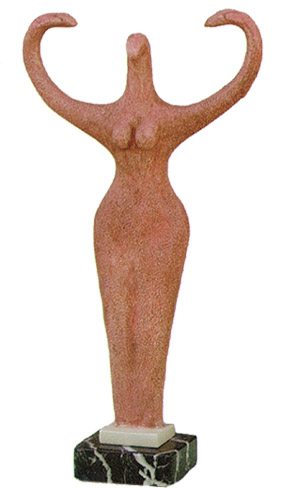
This is one of my favorite pieces of Paleolithic art. It has been called an abstract female figure, but it could be stylized portrayal of a male part, or something completely different.

An interesting discussion on the portrayal of prehistoric women in popular media can be found in the Forum for Gender & Culture.
This is one of my favorite pieces of Paleolithic art. It has been called an abstract female figure, but it could be stylized portrayal of a male part, or something completely different.

An interesting discussion on the portrayal of prehistoric women in popular media can be found in the Forum for Gender & Culture.
Prehistoric Women
Here's the popular image, ca. 1950:

Who needs an archaeology of sex roles when we already have such a clear idea of what our past was like?
Well, there have been a few changes. Here's an image from 1986:


Who needs an archaeology of sex roles when we already have such a clear idea of what our past was like?
Well, there have been a few changes. Here's an image from 1986:

Happy New Year
New Year's is a harmless annual institution, of no particular use to anybody save as a scapegoat for promiscuous drunks, and friendly calls and humbug resolutions. ~ Mark Twain
Thursday, December 29, 2005
Goddesses, Gender & Archaeology
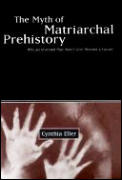 The Myth of Matriarchal Prehistory: Why an Invented Past Won't Give Women a Future, by Cynthia Eller is a fascinating read, one that highlights some of the many divisions among feminists.
I've always considered myself a feminist (at least for the last thirty years or so), but I never considered spirituality a part of that. On the contrary, my feminist interests tend toward science, and in graduate school in anthropology I helped put together a course called "A Gendered Past" that examined feminism and its application to prehistory.
In the last decade, the divisions between feminist archaeologists and what Eller calls "feminist matriarchalists" seem to have deepened, despite some valiant attempts at conciliation and tolerance on both sides. Check out Belili Production's webpage on What's the Debate? Marija Gimbutas - Legacy and Controversy for some recent discussions, and to explore some of the differing beliefs concerning women in prehistory.
Natalie Angier gave an even-handed review of Eller's book in the New York Times after its initial publication, but not all responses were so measured.
Lawrence Osborne's False Goddess, a review article in Salon, seems to revel in destroying the "lushly hysterical account of the rise of wicked, war-loving patriarchy", while simultaneously deriding anthropological and archaeological work on gender as "woolly" and "long on hot air, but rather short on empirical detail". While I can't deny the "hot air" in the sometimes undecipherable and torturous theoretical literature on gender and archaeology, I think recent work* shows that Osborne's statement that "Shards of pottery, meanwhile, are not especially eloquent about "gender relations" is downright shortsighted.
Amazon's reviews reveal some of the less coherent but impassioned responses to Eller's book:
"...she isn't worth whatever money she scrapes up from the misogynistic phallus worshipping patriarchal society she has obviously came to know and love. 'Glaring ignorance' should be listed on her credentials."
"However I guess since a male dominated Patriartical society has done a good job at distorting and destroying ancient Goddess evidence people have a hard time believing what is clearly in front of their eyes. The sadder part is that it is written by a woman, but I guess that when you are afraid of your own herstory and women's empowerment it is easy to support writtings that add to one's egotistical and false assumptions. All I can say is that if you are a TRUE Goddess woman you would be better to spend your time reading books like The Great Cosmic Mother which speaks of women's cultures and destruction by Patriarchy. The only real illusion here is the false notion that Patriarchy has always ruled. How very sad for everyone."
Now, being told that I have been "blinded by the patriarchy" or "brainwashed by the establishment" is just as annoying coming from a goddess worshipper as it was when Linda Hirshman said it about stay-at-home mothers. In both cases, I feel like I'm arguing with a religious fundamentalist whose devotion to dogma is stronger than any evidence that I could ever produce. And how on earth can I prove I haven't been totally blinded by the patriarchy? I can't prove that any more than I can prove that I'm free of original sin, and of course we are all undeniably influenced by our culture and history.
At any rate, I found The Myth of Matriarchal Prehistory an absorbing examination of feminism's spiritual roots and its use of myth, and a very interesting discussion of the implications of belief in this particular myth (or theory, if you prefer). As one of those "feminist archaeologists", I thought Eller handled the archaeological evidence (and the often abstruse archaeological literature) very well, with logic and balance and a nice assembly of illustrations.

*see for example, Gilpin & Whitley's Reader in Gender Archaeology; Nelson & Rosen-Ayalon's In Pursuit of Gender; Joyce's Gender and Power in Prehispanic Mesoamerica, or numerous other recent works. Just google "gender archaeology (or archeology)" and "gender prehistory". Unfortunately, you need an academic translator for some of these books; someone should write a book like Charles Mann's 1491 on this topic. Maybe I can do it when my daughter starts kindergarten.
Tags:
Interesting Question...
...from my nine year old son: "If we had a time machine and could go back in time and get a saber-toothed tiger for our house, would you be allergic to that like a regular cat?"
Friday, December 23, 2005
Santa in 1902

From the American Memory archives at the Library of Congress: a somewhat gaunt Santa Claus collecting for a Chicago charity.
Wednesday, December 21, 2005
Suntree Farms

There's a certain Slant of light,
Winter Afternoons --
That oppresses, like the Heft
Of Cathedral Tunes --
- Emily Dickinson, No. 258
5th Carnival of Feminists
is up at ScribblingWoman. As usual, I am particularly impressed by the multicultural posts - these are things I just don't read in the more mainstream media. Not I that I ever find more than a few superficial articles on feminism in newspapers or magazines, for the most part. But check it out, really.
A few of my favorites from what I've read so far: The Price of Motherhood is a thoughtful discussion on the Slate article on Amalia Miller's well-designed economic research; and Consider the Hijab: Blogging Against Racism.
A few of my favorites from what I've read so far: The Price of Motherhood is a thoughtful discussion on the Slate article on Amalia Miller's well-designed economic research; and Consider the Hijab: Blogging Against Racism.
Sunday, December 18, 2005
Monkeyluv
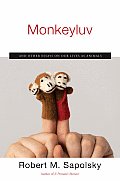 Monkeyluv: And Other Essays on Our Lives as Animals, by Robert M. Sapolsky was a fantastic, educational, funny, well-written book. I absolutely loved it. When it isn't brand-new and it comes down in price, I will buy my own copy to keep (this one was from the library).
Sapolsky is a neurobiologist at Stanford who studies stress hormones and their effect on health. He does field work with baboons in east Africa (detailed more in A Primate's Memoir, which I blogged about here).
In this collection of essays, originally written for magazines like Natural History, Discover, and Men's Health, he writes about our genes and how they interact with our environment. He explains things like why people who think nature always trumps nuture are wrong (or don't know how genes work), depression and PTSD and how a susceptibility for these disorders can be inherited (but not always developed), sexual attraction, dreams, cross-cultural religious patterns, Munchausen's by proxy, and more.
Since the essays were originally written for popular magazines, they are short and very readable. At the end of every essay, he's added a nice "further reading" section that tells you about the research about this issue, more technical works you may want to read, and interesting asides.
This is the kind of popular science we need to see a LOT more. It doesn't oversimplify the issues, but it doesn't bore the reader.
I could go on and gush about every single essay, but I'll stop here and just tell you to read the book if you're at all interested in your biology and your environment and health. Or recent scientific studies on any of these issues.
On "The Stay-At-Home Mystique"
After thinking about it a bit, I don't think there's much I can add to Naomi's critique of Rebecca Traister's Salon article, "The Stay-At-Home Mystique".
Like Naomi, I'm annoyed by both the author and the woman interviewed. It would have been nice if the editor from Total 180! magazine had answered Traister with some insight into the financial and cultural pressures that induce some women to stay home, rather than implying that if mothers didn't, all kinds of modern weirdness would ensue: kids joining gangs and participating in sexual activities in elementary school.
And Traister could have thought of some more interesting questions rather than just stirring the "Mommy Wars" pot with The Feminine Mystique. And still, nobody mentions Peskowitz's definitive work on this very topic. I really don't get it.
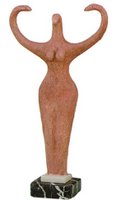 One part that did stick in my mind (and my craw) was the magazine editor's vague notion of a prehistoric matriarchy, as exemplified by Marion Zimmer Bradley's fantasy classic The Mists of Avalon. And although this was obviously a fumble in the dark for a relevant reference, more recent feminist writings, including one by The-Goddess in the last Carnival of Feminists shows that this idea is far from lost in the mists of the past. And that will be a subject for a future post.
Like Naomi, I'm annoyed by both the author and the woman interviewed. It would have been nice if the editor from Total 180! magazine had answered Traister with some insight into the financial and cultural pressures that induce some women to stay home, rather than implying that if mothers didn't, all kinds of modern weirdness would ensue: kids joining gangs and participating in sexual activities in elementary school.
And Traister could have thought of some more interesting questions rather than just stirring the "Mommy Wars" pot with The Feminine Mystique. And still, nobody mentions Peskowitz's definitive work on this very topic. I really don't get it.
 One part that did stick in my mind (and my craw) was the magazine editor's vague notion of a prehistoric matriarchy, as exemplified by Marion Zimmer Bradley's fantasy classic The Mists of Avalon. And although this was obviously a fumble in the dark for a relevant reference, more recent feminist writings, including one by The-Goddess in the last Carnival of Feminists shows that this idea is far from lost in the mists of the past. And that will be a subject for a future post.
Saturday, December 17, 2005
Matters of Style and Presentation
I have to admit that part of the reason that I don't like the Darla Shine media group's magazine, Total 180! (the subject of Rebecca Traister's Salon article, which I still haven't written about) is because the whole cutesy "Happy Housewives 50's anti-intellectual chic" sets my teeth on edge. I much prefer Brain, Child magazine's slightly edgy literary presentation, which I think is aimed at the same audience of "mothers who think".
 I wonder if the same subset of women that love Happy Housewives would like HRT's new Kiss My Axe cd. After listening to a sample of their lyrics & music (at the cd link above), I'm definitely sold on HRT. Unfortunately, I can't listen to it while driving my kids around in the minivan, as they would certainly learn some new vocabulary we're trying to keep them from picking up. I'm hearing "Jingle Bells, Batman Smells" enough as it is.
 I wonder if the same subset of women that love Happy Housewives would like HRT's new Kiss My Axe cd. After listening to a sample of their lyrics & music (at the cd link above), I'm definitely sold on HRT. Unfortunately, I can't listen to it while driving my kids around in the minivan, as they would certainly learn some new vocabulary we're trying to keep them from picking up. I'm hearing "Jingle Bells, Batman Smells" enough as it is.
Wednesday, December 07, 2005
Read the 4th Carnival of Feminists...
...and not just because there's a post by me (in the "Women's Work" section), but because it is really interesting. It's got controversy, it's got Birkenstocks, ancient goddesses, a look at chick flicks, lawyers, guns and money and feminist Mormon housewives, and more.
4th Carnival of Feminists
Tuesday, December 06, 2005
Book Index Works
Sorry about the lack of a working link for the book index. It works again now. I wish Blogger had an easy way to post selected links to your own blog archives in the sidebar. I like those "reading now" book cover pictures some people put in their sidebars. Except I would have to change the damn thing every other day, as I'm pretty much always reading a couple different books. And I would probably only want to put the intellectual looking ones in the sidebar.
Next up, because I can't stay away from the topic: a look at Rebecca Traister's Salon article, The Stay-at-Home Mystique. Yes, you have to watch an advertisement in order to read the article, but it's worth it to read all the responses to it. And the excerpts and responses on Pandagon and 11D.
Argh. Why isn't anyone citing Miriam Peskowitz's book? The Truth Behind the Mommy Wars covers these questions with interesting research, logic, and compassion. But all anyone can talk about is Happy Housewives and Desperate Housewives.
Next up, because I can't stay away from the topic: a look at Rebecca Traister's Salon article, The Stay-at-Home Mystique. Yes, you have to watch an advertisement in order to read the article, but it's worth it to read all the responses to it. And the excerpts and responses on Pandagon and 11D.
Argh. Why isn't anyone citing Miriam Peskowitz's book? The Truth Behind the Mommy Wars covers these questions with interesting research, logic, and compassion. But all anyone can talk about is Happy Housewives and Desperate Housewives.
Monday, December 05, 2005
The Three-Martini Playdate
 subtitled A Practical Guide to Happy Parenting, by Christie Mellor, is a very funny book that you probably have to be a parent to appreciate. As a commenter pointed out when I trashed Confessions of a Slacker Mom, this book captures a certain bracing tongue-in-cheek attitude perfectly, without the condescension and holier-than-thou feeling that drips from the Slacker Mom. Yes, Mellor goes a bit over the top sometimes. It's like those Saturday Night Live skits that are so funny, then just veer into poor taste. But overall, the whole thing is still damn funny and worth watching (or reading, in this case). Besides, it's short, only 143 pages. It would be a good choice to balance out the over earnestness of the Sears' Baby Book as a baby shower gift.
Here's an illustrative excerpt from "The Family at Table" chapter:
We have all seen those glossy photo spreads in gourmet food magazines of the joyful yet sophisticated Italian family sitting down to a long table, alfresco, joined by aunts, uncles, and happy wide-eyed youngsters. The children are seemingly enchanted by their watered-down glass of wine, their plates heaped with blood sausage and fava beans. We are led to believe that the adorable Italian children do not pick the garlic and onions out of their food, nor do they bolt from the table after the five minutes it takes them to suck back nine noodles and a baby carrot, leavng you with gaping holes in the well-thought-out alfresco seating arrangement.
If you like this, you'll probably like the rest of the book. The retro pencil illustrations by the author are wonderful, and perfect for the book.
Final Feminism & Choices Post
OK, this is the last post I'll urge you to read. But the comments are so thought-provoking! See Litmus Test Feminism at Half Changed World.
Sunday, December 04, 2005
Mothers & More again
It occurs to me that I should post a link for the local chapter of Mothers & More, in case anyone in Washtenaw County or the surrounding area is interested. A once a week toddler playgroup saved my sanity back in 1998 when I was home with my son and most of my friends were childless.
From the national organization's Advocacy and Action page:
Mothers & More has two primary goals for its advocacy programs:
From the national organization's Advocacy and Action page:
Founded as both a support and advocacy organization, Mothers & More has been on the forefront of a "mothers' movement" since the '80s, advocating for business and government policies that recognize and support the critical social and economic work all mothers perform as primary caregivers.
Mothers & More has two primary goals for its advocacy programs:
* To raise consciousness, in mothers and others, about existing social, economic and cultural conditions that have an impact on mothers.
* To secure economic and social equality for all mothers.
Through our comprehensive programs and our nationwide network of members and chapters, we strive to raise awareness about the fact that society presents significant barriers to mothers' ability to succeed as women, citizens, parents or participants in the workforce. We also provide the means to empower mothers, providing the education, knowledge and tools they need to effect social change on behalf of themselves and all mothers. By working through both the public and private sectors, we aim to transform society in three areas:
* We seek broad acceptance that the work of caring for others is valuable and essential to our families, communities and society as a whole.
* We believe that all mothers, fathers and others who care for their families, whether or not they work for pay, merit access to basic public and private protections from economic risk.
* We need to reshape our workplaces so that mothers, fathers and others who need to care for their families have more and better options for combining achievement on the job with a successful home life.
Mothers & More represents mothers who are at home full-time, mothers who work for pay full-time, and everything in between. We understand that, due to choice or circumstance, not all mothers make identical decisions. Some leave paid employment entirely and spend a number of months or years at home full-time. Others pursue volunteer work or continue working for pay but opt for flexible work options including part-time, flex-time, flex-place, job sharing, and home-based businesses. For over fifteen years, Mothers & More has been uniting women from all walks of life, supporting them through the rewards and challenges of motherhood.
As a non-profit organization serving 7,500 mothers in the U.S. and beyond, Mothers & More is poised to play a leading role in creating a society whose practices and policies successfully balance the needs and interests of those who work for pay, those who care for their families, and those who do both.
Over-Educated Stay-at-Home Moms Made Feminism Fail
This could be an alternative title for Linda Hirshman's Homeward Bound article published in the December issue of The American Prospect magazine. Since being picked up by AlterNet and retitled America's Stay-at-Home Feminists*, this article has been a source of great debate amongst bloggers - especially those that are also feminists and mothers.
There are so many critiques and comments out there (many of them written much more cogently and persuasively than Hirshman's article) that a couple of helpful bloggers have compiled collections of links to aid readers who want to explore the different types of responses. Ann Bartow on Sivacracy.net has one of the most interesting ones, at Linda Hirshman Makes Me Feel Like a Freak (with a follow-up entitled Wolf Dressed in Feminist Clothing). 11D offers a delightful commentary called Invisible Worlds, followed by an entry simply titled Links, taking you to several other well-known blogger's musings, and then some interesting Thoughts on Crazy Week. MUBAR wrote a couple of very insightful columns for both her blog and the Literary Mama Blog: The "Elite" Talk Back and The "Elite" Talk Back: Linda Hirshman and Miriam Peskowitz Respond.
Linda Hirshman's comments and e-mails to several blogs are interesting in their own right, and just as inflammatory and patronizing as her original article:
Speaking of hierarchy: Hirshman knows the truth about feminism and its failure, and her many detractors are fuzzy thinking, hysterical women that busy themselves with the trivial in some kind of alternate (and weird) universe.
Since I am a stay-at-home mother with a couple of degrees in anthropology, I almost fit into Hirshman's "cultural elite". I did work for about ten years in my chosen career. I certainly never became affluent, but as Hirshman notes, this is common in the Liberal Arts & Sciences, which thus ought to be shunned by real feminists. My own "opt-out" from my dissertation and the pursuit of an academic job was certainly influenced by childcare costs and the lack of its availability for a child with some special needs; it was also largely why I joined Mothers & More - a national support group for mothers that was called FEMALE: Formerly Employed Mothers At the Leading Edge back when I joined in 1998.
However, in contrast to the New York Times brides that Hirshman interviewed for her article, I have met very few other mothers that are "not committed to a life of work"; most of us would like to resume paid (and preferably meaningful) employment as our children age. If we can find it. Many of us would currently jump at the chance for part-time employment, or work with hours that are more flexible and more family friendly....but this is another another topic, and one that has been well covered by authors like Miriam Peskowitz and Judith Stadtman Tucker. Obviously, since Mothers & More is all about support for women that chose to "sequence", or interrupt their careers, my sample of friends and acquaintances is pretty self-selecting. But I think that the very fact that this organization exists calls Hirshman's assumptions that most stay-at-home mothers are happy with the status quo (or simply deluding themselves when they call themselves "feminists") into question.
Hirshman claims that in addition to failing society, mothers who leave their jobs for childcare are hurting themselves individually:
Although Hirshman firmly places mothers without paid employment on the bottom of her ideological and intellectual hierarchy**, the flood of eloquent responses to her article makes it clear that these women have not lost their ability to reason and speak. They may not have as much autonomy (especially when it comes to available jobs, financial security, and social status) as they desire, but I find it difficult to believe that they are doing more harm than good by caring for their own children full-time. But unlike Hirshman, I don't think that "private lives have hardly budged" in the last generation, nor do I see evidence that "marriage is essentially unchanged" in the last fifty years. I do think that a lot more women would be willing to identify themselves as feminists if they saw the pursuit of increased autonomy for caregivers - however many hours they get paid for their work - as part and parcel of the feminist ideology.
*note the 270 response comments in the week since it was posted
**see an interesting discussion on whether stay-at-home parents can think at Half Changed World's Do Only Rich Families Have At-Home Parents?, More Thoughts about Income and SAHP's, and especially What It Takes.
There are so many critiques and comments out there (many of them written much more cogently and persuasively than Hirshman's article) that a couple of helpful bloggers have compiled collections of links to aid readers who want to explore the different types of responses. Ann Bartow on Sivacracy.net has one of the most interesting ones, at Linda Hirshman Makes Me Feel Like a Freak (with a follow-up entitled Wolf Dressed in Feminist Clothing). 11D offers a delightful commentary called Invisible Worlds, followed by an entry simply titled Links, taking you to several other well-known blogger's musings, and then some interesting Thoughts on Crazy Week. MUBAR wrote a couple of very insightful columns for both her blog and the Literary Mama Blog: The "Elite" Talk Back and The "Elite" Talk Back: Linda Hirshman and Miriam Peskowitz Respond.
Linda Hirshman's comments and e-mails to several blogs are interesting in their own right, and just as inflammatory and patronizing as her original article:
I think -- and can defend the opinion -- that perpetuating hierarchy with women on the bottom by psychological, ideological, economic or any other means is immoral whether it occurs in the family or in the pages of the New York Times. So I don't blog on about my roofer or my morning sickness or whatever qualifies as sincere feminism in the weird space the internet creates," from LiteraryMama's comments.
"I will say this: I have answered almost none of the hysterical internet commentators on my article, because I am not interested in engaging in dialogue with people whose thinking cannot sharpen or challenge my own," as cited by Ann Bartow.
Speaking of hierarchy: Hirshman knows the truth about feminism and its failure, and her many detractors are fuzzy thinking, hysterical women that busy themselves with the trivial in some kind of alternate (and weird) universe.
Since I am a stay-at-home mother with a couple of degrees in anthropology, I almost fit into Hirshman's "cultural elite". I did work for about ten years in my chosen career. I certainly never became affluent, but as Hirshman notes, this is common in the Liberal Arts & Sciences, which thus ought to be shunned by real feminists. My own "opt-out" from my dissertation and the pursuit of an academic job was certainly influenced by childcare costs and the lack of its availability for a child with some special needs; it was also largely why I joined Mothers & More - a national support group for mothers that was called FEMALE: Formerly Employed Mothers At the Leading Edge back when I joined in 1998.
However, in contrast to the New York Times brides that Hirshman interviewed for her article, I have met very few other mothers that are "not committed to a life of work"; most of us would like to resume paid (and preferably meaningful) employment as our children age. If we can find it. Many of us would currently jump at the chance for part-time employment, or work with hours that are more flexible and more family friendly....but this is another another topic, and one that has been well covered by authors like Miriam Peskowitz and Judith Stadtman Tucker. Obviously, since Mothers & More is all about support for women that chose to "sequence", or interrupt their careers, my sample of friends and acquaintances is pretty self-selecting. But I think that the very fact that this organization exists calls Hirshman's assumptions that most stay-at-home mothers are happy with the status quo (or simply deluding themselves when they call themselves "feminists") into question.
Hirshman claims that in addition to failing society, mothers who leave their jobs for childcare are hurting themselves individually:
A good life for humans includes the classical standard of using one's capacities for speech and reason in a prudent way, the liberal requirement of having enough autonomy to direct one's own life, and the utilitarian test of doing more good than harm in the world.
Although Hirshman firmly places mothers without paid employment on the bottom of her ideological and intellectual hierarchy**, the flood of eloquent responses to her article makes it clear that these women have not lost their ability to reason and speak. They may not have as much autonomy (especially when it comes to available jobs, financial security, and social status) as they desire, but I find it difficult to believe that they are doing more harm than good by caring for their own children full-time. But unlike Hirshman, I don't think that "private lives have hardly budged" in the last generation, nor do I see evidence that "marriage is essentially unchanged" in the last fifty years. I do think that a lot more women would be willing to identify themselves as feminists if they saw the pursuit of increased autonomy for caregivers - however many hours they get paid for their work - as part and parcel of the feminist ideology.
*note the 270 response comments in the week since it was posted
**see an interesting discussion on whether stay-at-home parents can think at Half Changed World's Do Only Rich Families Have At-Home Parents?, More Thoughts about Income and SAHP's, and especially What It Takes.
Subscribe to:
Posts (Atom)


